Interior Design Styles
What's the real difference between "Modern Minimalist" and "Cream style"? These are probably the two most-confused light-toned styles of the past couple of years. Both look clean and contemporary, but their personalities are exactly opposite: one is crisp and cool, the other soft and warm. Miss that distinction and you'll easily end up with an awkward space that's neither cool nor warm — just stuck in the middle.
This guide uses a comparison table to clear up the difference in one pass, then digs into Cream style and Modern Minimalist's palettes, materials, and living room styling separately, before showing you how to blend the two into a "Modern Japanese mix." To see where they fit among the 8 major styles first, go back to the Interior Design Styles Overview.
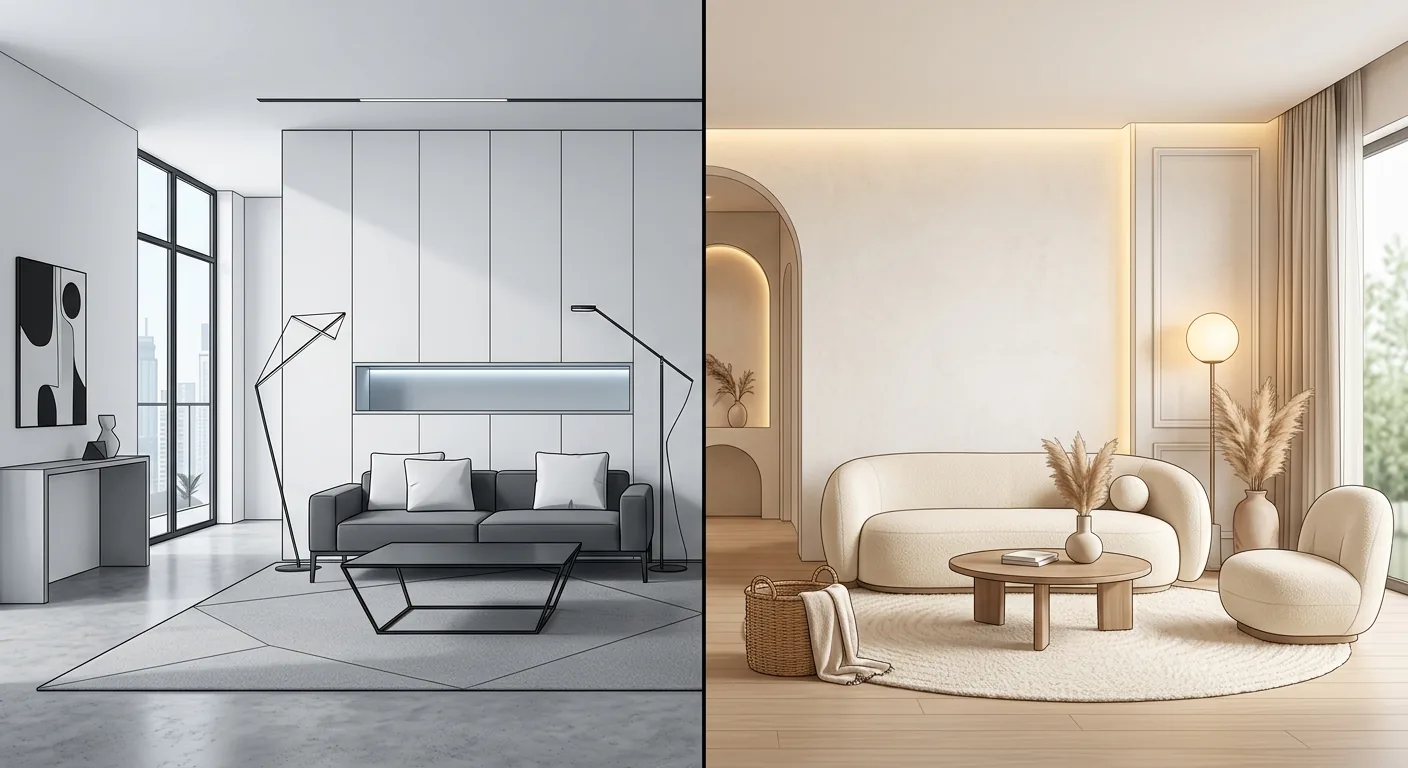
Caption: Modern Minimalist (left, crisp and cool) vs. Cream style (right, soft and curved) side by side
Key takeaway: Research shows that homes with neutral, contemporary color tones tend to sell faster and for more than homes with dated or bold colors (Apartment Therapy/Fixr, 2025). Both Cream style and Modern Minimalist are timeless, neutral, light-toned styles, which is exactly why they've dominated in recent years.
One-sentence definition: Modern Minimalist = crisp and cool, Cream style = soft and warm. Both are timeless, neutral, light-toned styles, and neutral-toned spaces tend to be more popular in the market and sell faster (Apartment Therapy/Fixr, 2025). The difference: Minimalist uses achromatic tones and geometric lines to create order; Cream style uses warm tones and curves to create comfort. Once you understand this core distinction, everything else falls into place.
The keyword for Modern Minimalist is "crisp." White, gray, and black achromatic tones, geometric and flat lines, tidying the space into something clean and rational. The keyword for Cream style is "soft." Cream white and oat-toned warm shades, curved furniture and rounded edges, soaking the space in gentle comfort.
One is like a calm architect, the other like a warm hug. Which personality you're drawn to usually gives you your answer right there.
| Dimension | Modern Minimalist | Cream Style |
|---|---|---|
| Palette | White, gray, black achromatic | Cream white, oat, caramel warm tones |
| Materials | Glass, metal, lacquered panels | Microcement, fabric, warm wood |
| Furniture Lines | Geometric, flat, crisp | Curved, soft edges |
| Mood | Cool, rational, orderly | Warm, soft, comforting |
This table lays out four dimensions side by side for an at-a-glance comparison. For a closer look at color ratios, see the principles in Room Color Schemes.
Quick rule of thumb: if you like things clean, rational, and crisp, choose Modern Minimalist; if you like things gentle, comforting, and soft, choose Cream style. People with a calm, restrained personality tend to feel comfortable in Minimalist spaces; people who lean warm and emotional tend to click better with Cream style.
Natural light is also worth considering. A home with great natural light won't feel cold when done in Minimalist style; a home with average light can use Cream style's warm tones to add back some warmth. Do you want a crisp home, or a home that feels warm to the touch?
The core of Cream style interior design is "softness." Colors use warm tones like cream white, oat, and caramel, avoiding cool grays; furniture leans curved — curved sofas, arched forms, and soft edges are Cream style's identifying features; materials layer texture through microcement, fabric, and warm wood. This section gives you a direction you can shop straight from.
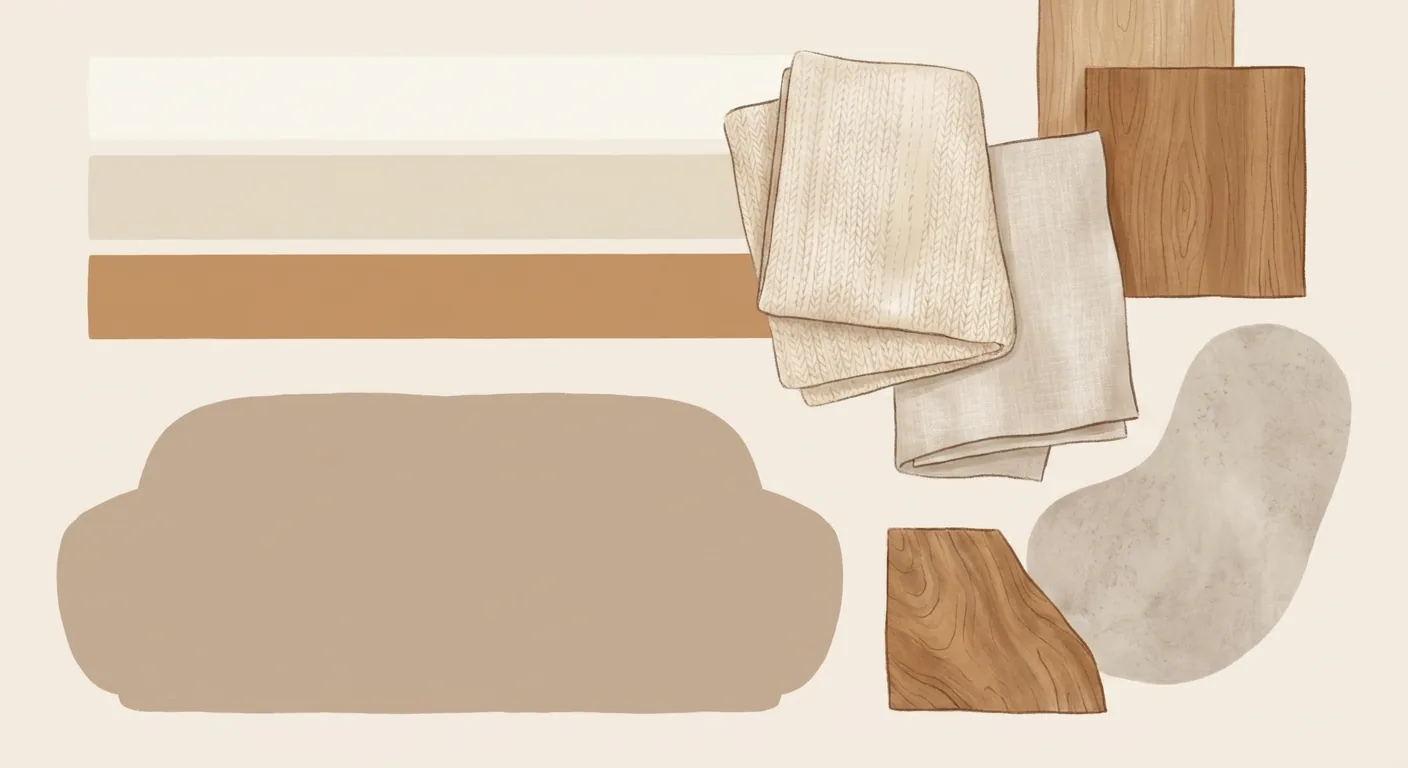
Caption: Cream style palette and materials — cream white, oat, and caramel warm tones, plus curved furniture and soft fabric
Cream style's palette runs warm. Cream white as the base, oat tones spread throughout, caramel as an accent — the whole palette reads like a cup of warm latte, soft and comforting. The key is avoiding cool grays and high contrast, which break Cream style's warmth.
Layers within the warm tones are the essence of Cream style. Take three or four different shades within the same warm color family and stack them to build a gentle sense of depth — it reads far richer than a single flat color.
Curves are Cream style's most recognizable feature. Curved sofas, arched doorways or wall openings, rounded coffee tables and cabinetry — these soft lines make the space feel gentle and unthreatening. Sharp, square furniture weakens Cream style's comforting feel.
That said, curved furniture usually takes up more floor space. A large curved sofa or round table's actual footprint is often bigger than you'd expect — worth paying close attention to before you buy, and we'll get into that in more detail below.
Cream style builds texture through materials. Microcement's warm, matte finish, fabric's softness, warm wood's coziness — these tactile materials make Cream style comforting not just to look at, but to touch. Avoid cold, hard metal and glossy finishes.
Texture is an easy-to-overlook part of Cream style. The same cream white reads completely differently on a matte microcement wall versus a glossy lacquered wall — the former feels gentle, the latter feels cold.
Modern Minimalist style is built on three pillars: crisp lines, minimal decoration, and integrated storage. Crisp lines carry through the "less is more" principle; minimal decoration relies on generous empty space and stripping away excess elements; integrated storage uses hidden storage to keep facades clean. Minimalist isn't empty — it's "every remaining item has a reason to be there." This section breaks down how to make a Minimalist look that stays timeless.
Modern Minimalist's lines are strictly geometric and flat. Square facades, crisp edges, and simple forms carry through the "less is more" spirit. Decorative molding, elaborate carving, and other excess elements are all stripped away, letting the space return to its cleanest form.
Clean lines are what make a space feel rational and orderly. When choosing furniture and cabinetry, pick simple lines and crisp forms, and don't let any single piece stand out and break the overall flatness.
Minimalism relies on empty space to carry the room. Generous wall space left blank, clear countertops, and excess decoration removed give the space room to breathe. This is somewhat similar to Japanese Minimalist's subtraction principle, but Modern Minimalist is cooler and emphasizes the order of lines more, rather than Japanese Minimalist's natural, rustic feel.
Minimal decoration doesn't mean cold and empty. The key is that every remaining item has a reason to exist — either function or a visual focal point, pick one. Anything without a reason is excess that should go.
Hidden storage is the key to a Minimalist look that stays timeless. Handleless cabinetry, storage flush with the wall, and function tucked into the facade keep the space looking clean and flat, with no visible clutter. This is the biggest thing that sets Minimalist apart from ordinary decorating.
Integrated storage needs to be planned at the design stage. Hiding storage into the facade requires calculating dimensions and placement in advance, which is exactly why Minimalist style depends so heavily on upfront planning. For a deeper dive into combining, dividing, and sizing hidden storage cabinetry, see the Cabinet Storage Design Guide.
Here are both styles' living room approaches, side by side for comparison. A Cream-style living room = warm walls + curved sofa + soft light; a Modern Minimalist living room = cool walls + crisp functional cabinetry + linear lighting. The shared principle: no more than three primary colors, and layered materials. Research also notes that living rooms in neutral colors like deep charcoal tend to be more popular in the market (Apartment Therapy/Fixr, 2025).
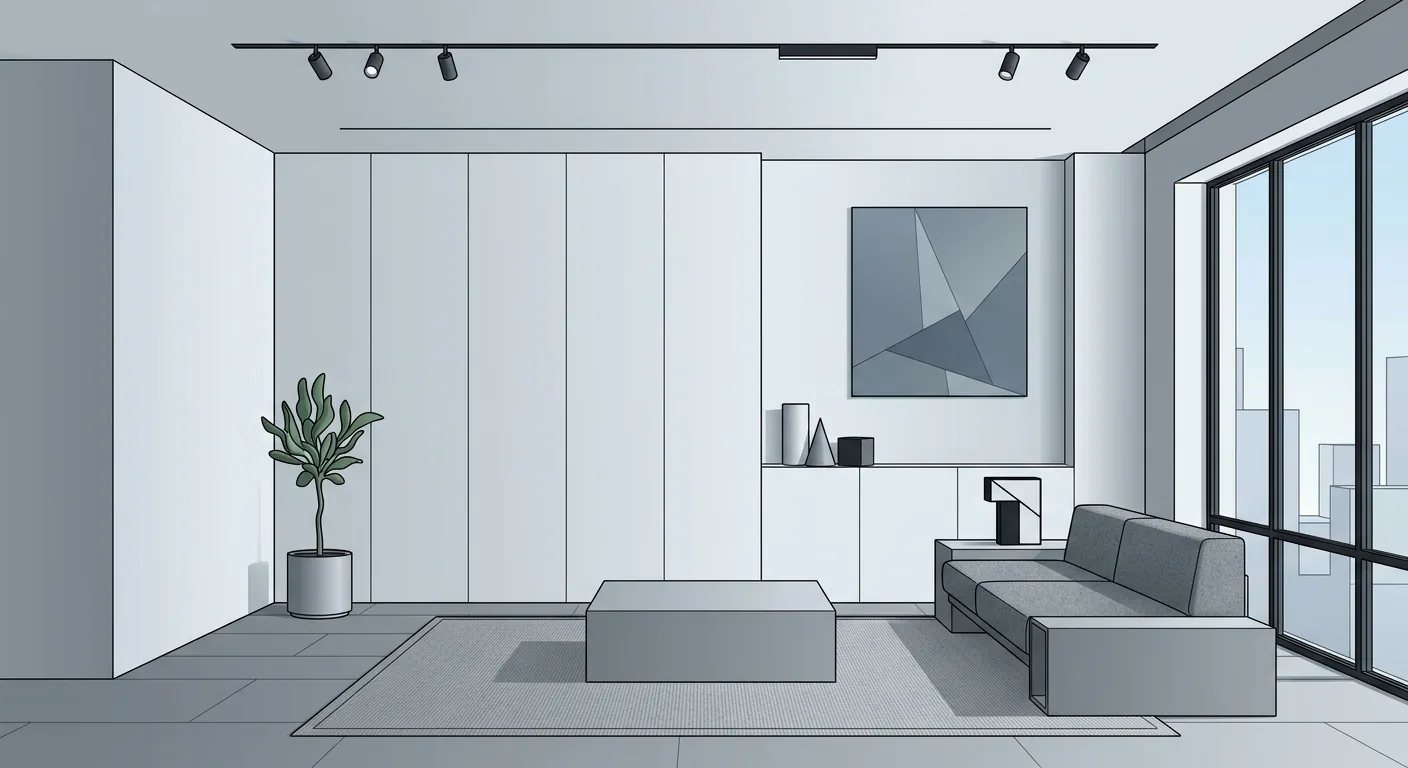
Caption: Modern Minimalist living room — cool walls, hidden storage facade, crisp low sofa, and linear lighting
The formula for a Cream-style living room is warm walls, a curved sofa, and soft light. Start with cream white or oat-toned walls as a base, add a curved sofa as the centerpiece, then use soft warm light (floor lamps, table lamps) instead of a cool white overhead fixture. The whole living room feels bathed in warmth, gentle and comforting.
Layer in soft furnishings — cushions and rugs in the same color family — to reinforce the softness. The biggest taboo in a Cream-style living room is a sudden hard-edged or high-saturation piece of furniture, which breaks the overall warmth.
The formula for a Modern Minimalist living room is cool walls, crisp functional cabinetry, and linear lighting. Achromatic white-gray walls, hidden storage cabinetry flush with the wall, paired with linear or recessed lighting, keep the living room clean and rational. Deep charcoal is a popular, relatively timeless color for Minimalist living rooms (Apartment Therapy/Fixr, 2025).
Choose furniture with crisp lines and simple forms, and pare the quantity down to what's necessary. A Minimalist living room's beauty lies in the flatness and order of its facades — don't let clutter or excess furniture break that. For a full living room layout plan, see the Complete Living Room Design Guide.
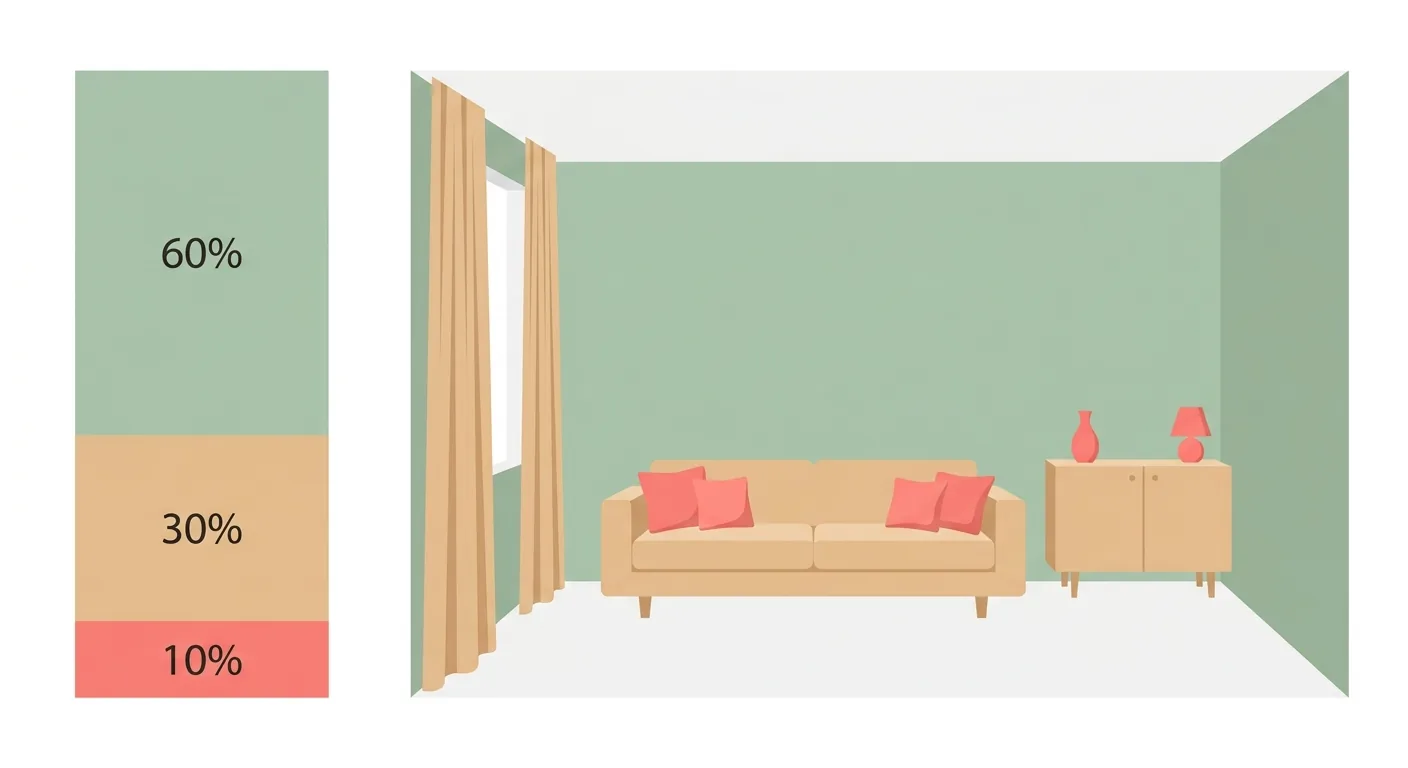
Whichever style you're doing, two shared principles apply. First, no more than three primary colors — too many colors quickly turn chaotic, so staying within three is the safest bet. Second, layered materials — stack different materials (wood, fabric, stone, metal) to create depth, avoiding the monotony of a single material carrying the entire space.
These two rules are the foundation of a light-toned look that stays timeless. Have you noticed how the same light tone can look expensive in one space and flat in another? The difference is often whether the materials are layered.
Modern Japanese and Minimalist style blend together easily, because they're naturally compatible. Modern Japanese's foundation — light wood plus minimalist lines plus empty space — pairs seamlessly with Modern Minimalist's crispness. The rule for mixing: pick one primary style, add one accent element, and tie them together with a single unified palette, avoiding a patchwork look.
Modern Japanese combines Japanese light-wood texture with Modern Minimalist's crisp lines. It keeps Japanese style's light wood, empty space, and natural feel, strips away traditional Japanese style's ornamentation, and swaps in Minimalist's clean facades. This combination is both warm and crisp, and has become a popular mixing direction in recent years.
To pull off Modern Japanese well, the ratio of light wood and the rhythm of empty space are key. For a deeper dive into the Japanese foundation, see the full Japanese Minimalist Style guide.
The biggest risk in mixing styles is ending up with a mishmash. The safe approach: pick one primary style (say, Modern Minimalist), add one accent element (say, Japanese light wood, or a Cream-style curved armchair), then tie them together with a single unified palette. With a clear hierarchy and a unified palette, the mix works.
Don't let the two styles split the spotlight evenly. One should be the lead, one the supporting act — that's what gives the space a center of gravity. For a more systematic approach to unifying palettes, see the principles in Room Color Schemes.
Whether you're doing Modern Minimalist or Cream style, precise dimensions are what make either one look good. Minimalist depends on integrated storage and clean lines, and hidden storage needs its dimensions calculated in advance; Cream style's curved furniture tends to take up more floor space, with a large curved sofa's actual footprint often bigger than expected. That's exactly why verifying that the furniture fits and the clearances work should come before choosing colors and materials.
Each style has its own dimension challenge. Minimalist's hidden storage must sit flush with the facade at precise dimensions — even a small miscalculation ruins the flatness. Cream style's curved furniture takes up more floor space — a curved three-seat sofa's actual footprint can be considerably larger than a square sofa with the same seating capacity. Both need to be calculated in advance.
A situation we see often: a homeowner falls in love with a big curved sofa, only to find, once it's placed in the floor plan, that the walkway is completely blocked. Dimensions don't shrink just because a style is beautiful. To know the actual width, depth, and height of different sofa types before you choose, see the Complete Sofa Dimensions Guide.
Roomfit lets you upload your floor plan and place furniture into it at true 1:1 scale, showing you directly how much space a curved sofa takes up, whether the hidden cabinetry fits, and how much walkway remains, with the system automatically marking the clearances. You can confirm the dimensions work before buying furniture or committing to custom carpentry.
Once dimensions are verified, go back and choose your colors and materials, so you don't end up buying a big curved sofa only to discover the walkway is blocked. Get the fit right first, then worry about looks — that's the order that works for both styles. After reading about these two light-toned looks, you can also go back to the Interior Design Styles Overview or check out the Scandinavian Style comparison.
Modern Minimalist and Cream style are two contemporary light-toned looks with opposite personalities: Minimalist is crisp and cool, Cream is soft and warm. Use the comparison table to sort out the differences in palette, materials, lines, and mood, then pick a primary style based on your personality and natural light, and you'll avoid ending up with an awkward space stuck in the middle. If you want to mix them, pick one primary style, add one accent element, and tie them together with a unified palette.
And both styles depend on dimensions. Minimalist's hidden storage needs precision, and Cream style's curved furniture takes up more room — before choosing colors, use Roomfit to verify the furniture fits and the clearances work. Get the fit right first, then worry about looks, and your light-toned home will end up both beautiful and livable.
In one sentence: Modern Minimalist is crisp and cool, Cream style is soft and warm. Minimalist uses white, gray, and black achromatic tones, geometric and flat lines, and hidden storage to create order and rationality; Cream style uses cream white, oat, and caramel warm tones, curved furniture, and soft materials to create comfort and warmth. On materials, Minimalist favors glass, metal, and lacquered panels, while Cream style favors microcement, fabric, and warm wood. If you like things clean and rational, choose Minimalist; if you like things gentle and comforting, choose Cream style.
Layering warm tones is the key. Cream white as a base, oat tones spread throughout, caramel as an accent — take three or four different shades within the same warm color family and stack them for depth, which reads far richer than a single flat color. Avoid cool grays and high contrast, which break Cream style's warmth. Materials should also be layered — microcement, fabric, and warm wood stacked for texture make the space comforting to touch, not just to look at. Keep your primary colors to three or fewer — too many colors quickly turn chaotic.
The formula is cool walls, crisp functional cabinetry, and linear lighting. Achromatic white-gray walls as a base, handleless hidden storage cabinetry flush with the wall to keep the facade clean, paired with linear or recessed lighting. Deep charcoal is a popular, relatively timeless color for Minimalist living rooms (Apartment Therapy/Fixr, 2025). Choose furniture with crisp lines, pare the quantity down to what's necessary, and let the flatness and order of the facades do the work. Hidden storage needs its dimensions calculated in advance, which is why Minimalist depends so heavily on upfront planning.
Yes, and they're quite compatible. Modern Japanese's foundation is light wood plus minimalist lines plus empty space, which already pairs seamlessly with Modern Minimalist. The mixing rule: pick one primary style, add one accent element, and tie them together with a single unified palette, avoiding a patchwork look. For example, use Modern Minimalist as the primary style and add Japanese light wood and empty space as accent elements, and you get a Modern Japanese look that's both warm and crisp. The key is a clear hierarchy and a unified palette — don't let the two styles split the spotlight evenly.
Arrange furniture in your space at true 1:1 scale with Roomfit and see exactly how much walkway is left — no install, no sign-up.
Start with Roomfit →