Interior Design Styles
You want your home to feel like a clean, calm Japanese Minimalist space, but no matter how many light wood pieces and white curtains you buy, something still feels off? The problem usually isn't the individual pieces — it's that you're missing Minimalist style's core logic: subtraction. The cleanness of this look comes mostly from what's hidden away, not what's bought and added.
This guide walks you through the three foundational tones of Japanese Minimalist style and its subtraction aesthetic, then shows you, step by step, how to style a Minimalist living room, choose cotton/linen curtains, build a small-space Japanese garden, and apply three storage rules that actually make a home feel calm. To see where this style fits among the 8 major styles first, go back to the Interior Design Styles Overview.
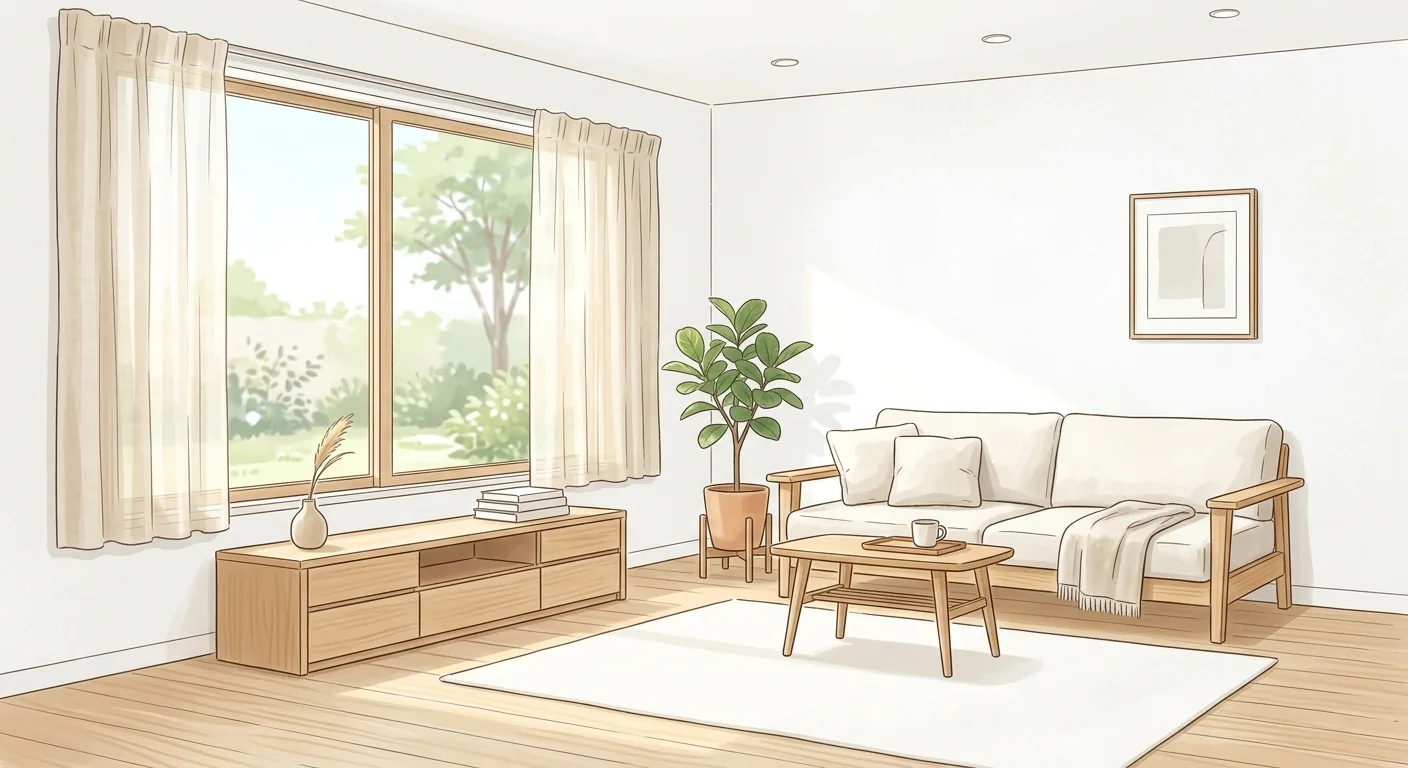
Caption: Japanese Minimalist living room — light wood flooring, white walls, low furniture, cotton/linen curtains, and bright natural light
Key takeaway: A UCLA study found that people who perceive their homes as cluttered have higher cortisol (stress hormone) levels throughout the day (Blue Cross Blue Shield, 2024). Minimalist style's calm feel comes precisely from storage hiding clutter away — the payoff isn't just aesthetic, it's a lower-stress way of living.
Japanese Minimalist style pares the home down to "just enough" for a clean Japanese look, built on three foundational tones: light wood, white walls, and cotton/linen. Its core isn't about what you buy — it's "subtract first, then add": remove the excess first, let empty space create a sense of calm, then add back a small number of essential items. This restraint isn't just aesthetic — it's psychological too: clutter raises stress hormone levels (Blue Cross Blue Shield, 2024).
The visual baseline of Minimalist style is easy to grasp — just three elements. Light wood — flooring and furniture in pale wood tones, warm and bright. White walls — large expanses of white as a base, expanding the space and serving as a backdrop. Cotton/linen — curtains, bedding, and cushions in cotton or linen fabric, bringing natural drape and softness.
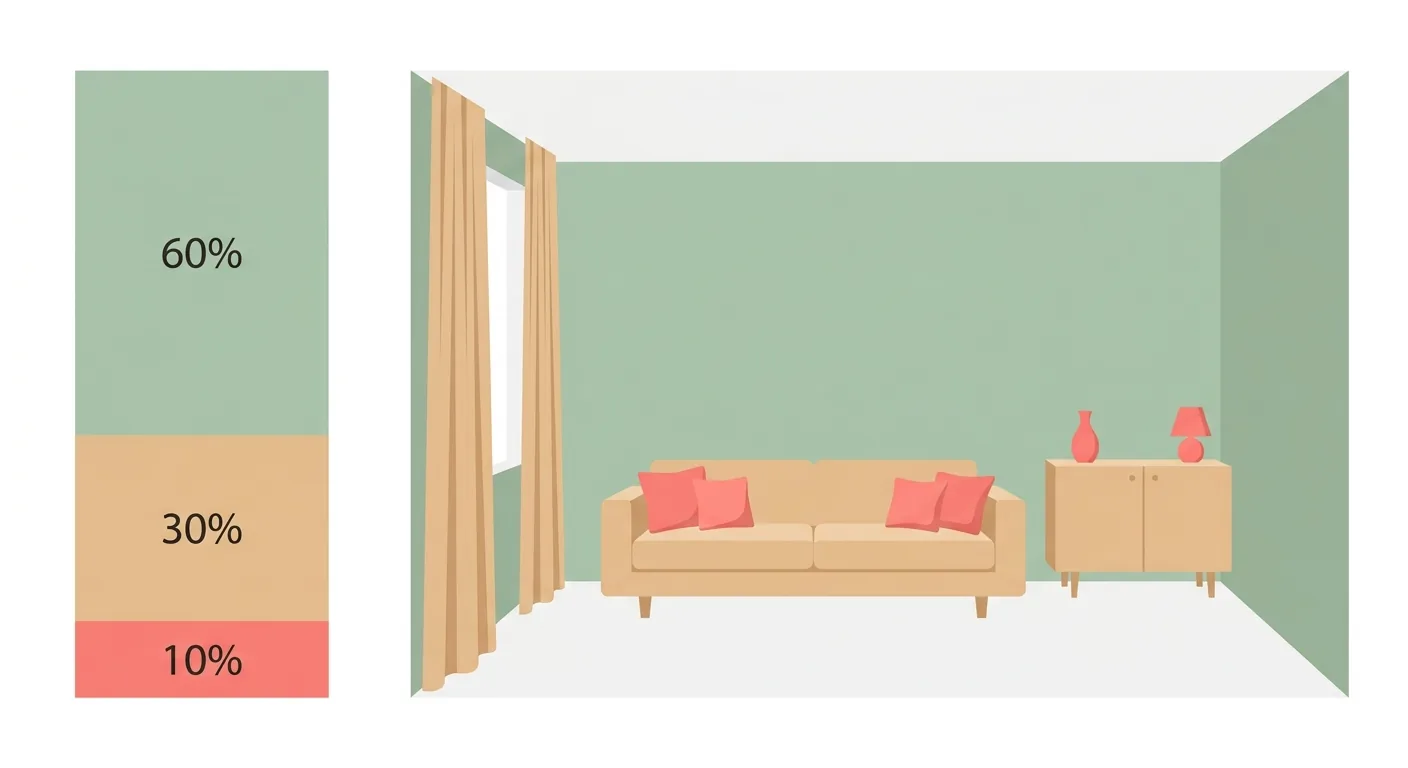
These three tones work together as the skeleton of Minimalist style. Master them and you've already got 70% of the way there. The remaining 30% comes from the subtraction principle and storage discussed next. To dial in the exact ratio of white, wood, and gray, see the 6:3:1 rule in Room Color Schemes.
The most common misunderstanding about Minimalist style is thinking that "buying Muji products" is the same as "Minimalist style." In fact, the soul of the style is subtraction: ask "can this go away" before asking "what should I buy next." Empty space creates the sense of calm, while objects are pared down to only what's necessary.
From my own experience helping countless homes get organized: the moment a space actually starts to feel calmer is almost always when something gets thrown out, not when something gets added. Get the subtraction right, and you're already halfway to Minimalist style.
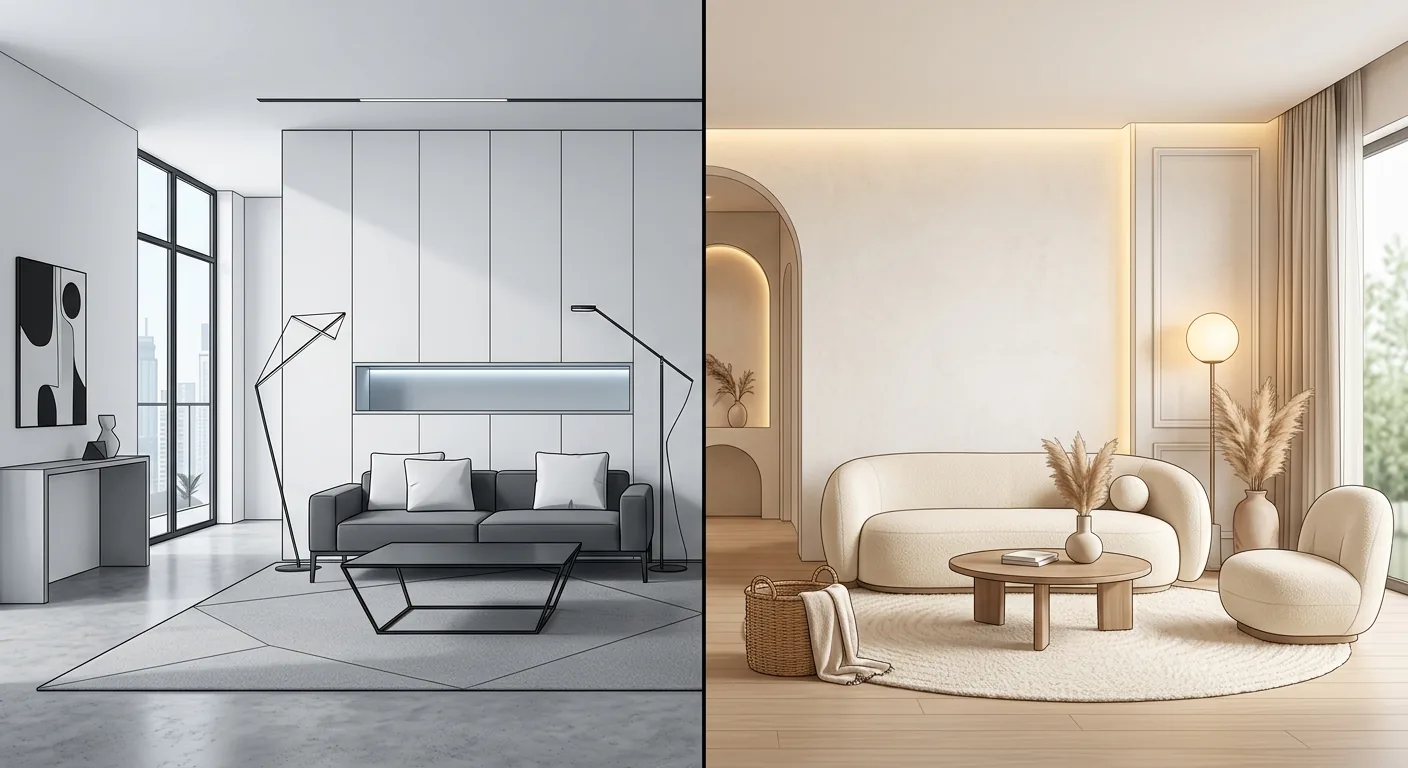
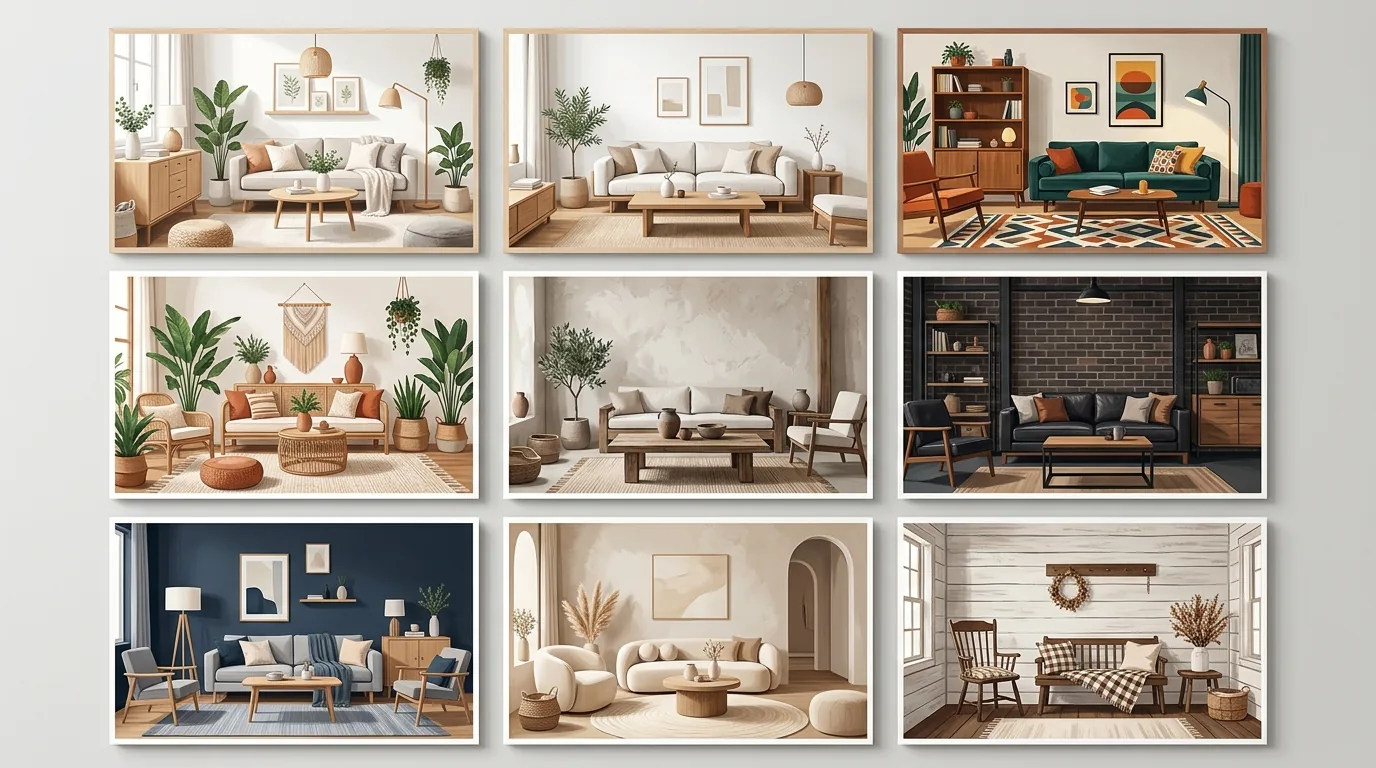
Light-toned styles are often confused with each other — here's a one-sentence way to tell them apart. Minimalist leans toward rational storage, with color strictly limited to white, wood, and gray, and almost no decoration. Wabi-Sabi leans toward rustic emptiness, using earth tones and handmade textures to build a sense of age. Scandinavian leans toward function with accent colors, pairing a white base and light wood with low-saturation color pops.
All three are light and clean, but their personalities differ. Minimalist is the most restrained, Wabi-Sabi the most rustic, Scandinavian the warmest and liveliest. For a deeper comparison, see the full guides for Wabi-Sabi Style and Scandinavian Style.
The key to a Minimalist living room is a low visual center and empty space. Use low furniture to lower the visual weight of the room and expand the sense of space, deliberately leave walls and countertops uncluttered, and layer in soft natural and indirect light. Research backs up how much natural light matters here too: a home's daylight design significantly affects emotional well-being (ScienceDirect, 2022). This section gives you actionable living room principles — for a full sofa, TV wall, and traffic flow plan, see the Complete Living Room Design Guide.
Minimalist living rooms favor low furniture, and that's not an arbitrary choice. A low sofa, coffee table, and TV console lower the visual center of the whole room, making the ceiling feel higher and the space feel bigger. This trick is especially effective for Taiwan's common small-to-mid-size homes.
The lower and simpler the furniture, the more open the space feels. When shopping, avoid high-backed, bulky pieces with elaborate carving — let furniture blend quietly into the space instead.
A Minimalist living room's biggest taboo is packing the walls and countertops full. Empty space isn't wasted space — it's the source of the calm feel. Leave large blank areas on the walls, keep countertops down to one or two necessary items, and the visuals get room to breathe.
You might wonder: won't a bare wall look boring? Actually, empty space paired with light wood and natural light is a visual statement in its own right. What's actually boring is a space that's packed full without a focal point.
Minimalist style takes a soft approach to lighting. Bring in plenty of natural light to keep the space bright, then layer in indirect lighting at night instead of relying on a single strong overhead fixture. Soft light makes the texture of light wood and white walls look even better.
Natural light is free decoration for a Minimalist living room. Choose light-permeable curtain fabrics, and keep furniture from blocking windows so light can pour in naturally and bring the space to life.
Choosing Minimalist curtains follows a clear standard: cotton or linen fabric, solid colors, and light transmission handled by room. The natural drape and translucency of cotton, linen, and sheer fabric is Minimalist style's signature look; solid, low-saturation colors keep it harmonious with light wood and white walls instead of competing with them. This section is a practical checklist you can shop straight from.
Prioritize cotton, linen, and sheer fabric for Minimalist curtains. Cotton and linen's natural drape and subtle wrinkling, and sheer fabric's soft light transmission, both suit Minimalist style's natural tone. Avoid glossy, slick, overly crisp synthetic fabrics — they read as cheap and stiff.
Get the fabric right, and the curtains already carry the Minimalist feel. The layers cotton and linen create as light and shadow move across them are something a synthetic curtain simply can't replicate.
Minimalist curtains stay in solid, low-saturation colors. Off-white, light gray, and raw cotton are safe choices that harmonize naturally with light wood flooring and white walls. Avoid large expanses of high-saturation color or bold patterns — they break the Minimalist calm.
Curtains take up a fair amount of visual area, and if the color goes off-tone, the whole living room falls apart. Solid color is what keeps curtains "invisible" — they should be a backdrop, not the star of the show.
Light transmission should be handled room by room. Bedrooms need blackout for sleep; public areas like the living room can stay sheer, letting natural light in. If you want both, use double-layer curtains — a sheer layer for daytime light and a blackout layer for when you need it.
A layered approach means you don't have to pick just one. My own advice: think through each room's light needs first, then decide whether double layers make sense — don't default to blackout everywhere and shut out all the light.
Japanese Minimalist style puts real weight on "bringing nature indoors," but Taiwan homes rarely have large gardens, so the focus is on small-space techniques. Use gravel, greenery, and raw wood to build a miniature Japanese landscape on a balcony or awkward corner, then borrow the scenery through a floor-to-ceiling window and planting so the indoor and outdoor visuals extend into each other. Even a small space can feel natural.
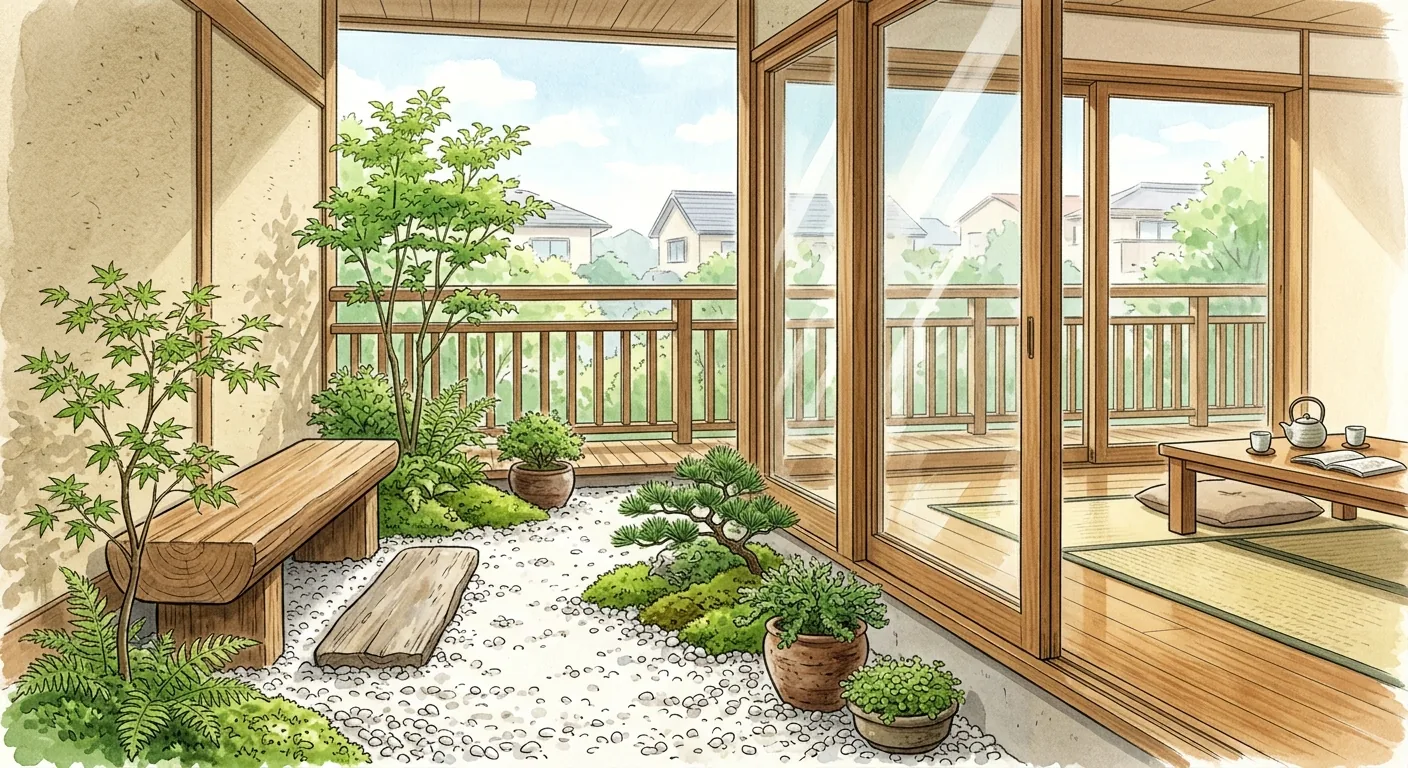
Caption: Small-space Japanese landscaping — gravel, greenery, and a wood stepping stone, extended indoors through a floor-to-ceiling window
Small-space Japanese landscaping comes together with three basic elements. Gravel — lay a small patch of white sand or gravel for the quiet feel of a dry rock garden. Greenery — a few naturally-posed potted plants bring life to the corner. Raw wood — wood decking, a stepping stone, or a wooden bench ties the whole corner's tone together.
You don't need a big space — one balcony corner is enough. The key is keeping the elements minimal and the empty space generous — don't let a small balcony turn into a storage dump.
Minimalist style's natural feel gets amplified through "borrowed scenery." A floor-to-ceiling window borrows the balcony's greenery into the interior, extending your sightline from indoors to outdoors and making the space feel bigger. Place one plant near the window and the greenery inside and outside reads as one continuous scene.
This trick is especially kind to small floor areas — your actual square footage hasn't changed, but visually you've gained a patch of green. For a full balcony or garden plan, which falls under room-by-room design, dive deeper into The Complete Balcony Styling Guide for storage and planting layout.
The calm feel of Minimalist style comes mostly from storage. Research shows cluttered environments raise stress hormone levels and can even extend the time it takes to fall asleep by about 20% (Blue Cross Blue Shield, 2024). There are three storage rules for Minimalist style: hide the clutter, unify your containers, and keep countertops clear. Minimalist isn't about "owning less" — it's about things being put away where you can't see them.
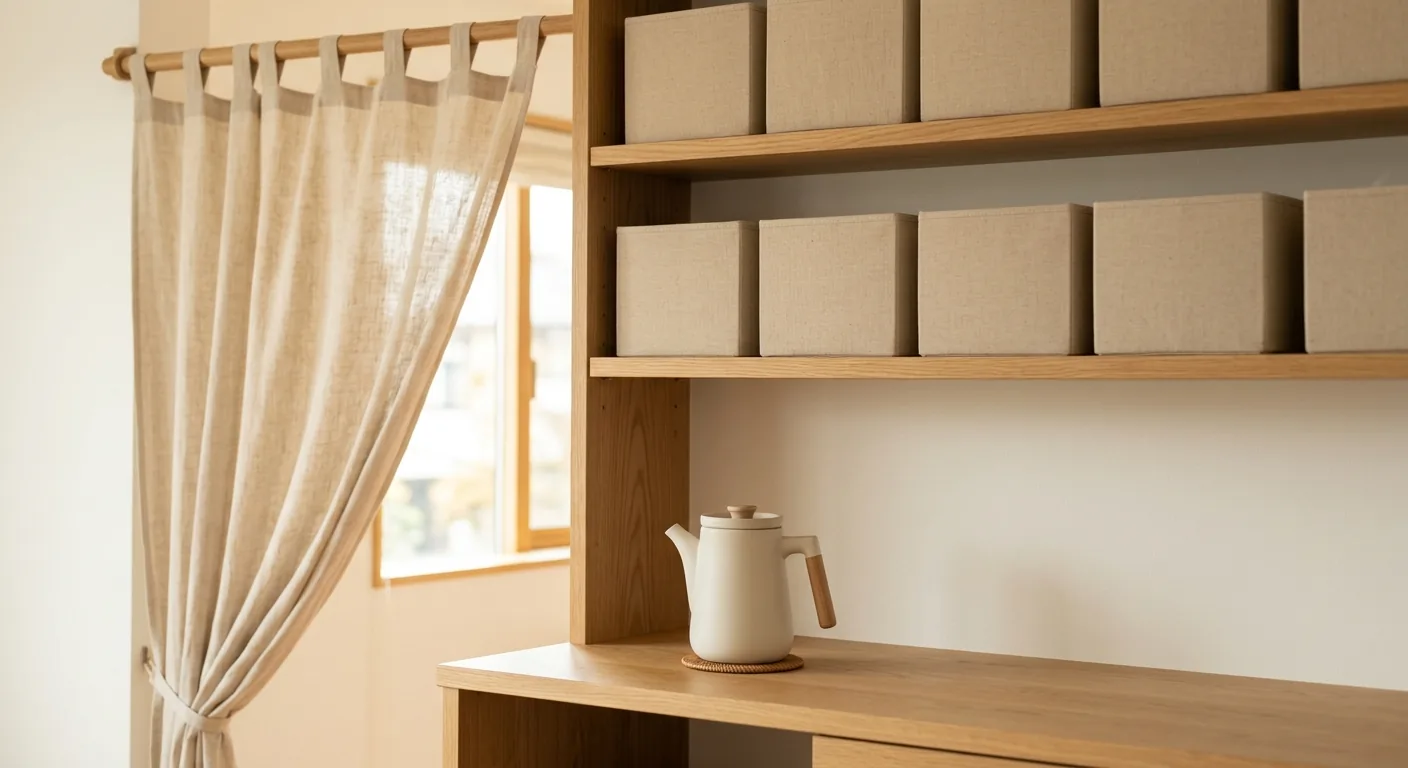
Caption: Minimalist storage details — plain cotton/linen curtains, unified containers, and a clear countertop
The first storage rule is hiding clutter: put things away where you can't see them. Built-in cabinetry, storage boxes, and drawers are your best friends — tuck cables, stationery, and miscellaneous items into them, exposing clean facades and countertops. Out of sight really does mean the space feels calmer.
Hiding clutter isn't about cramming things until they burst — it's about giving every item a designated "home." Items with a fixed spot are far less likely to wander onto your countertop. For a full storage volume and layout plan for small spaces, see The Complete Small-Space Storage Planning Guide.
The second rule is unifying your containers. Storage boxes in the same color and material, lined up together, dramatically cut visual noise. Colorful packaging and mismatched box sizes create chaos the moment you open a cabinet, even if everything's technically put away. Once unified, even the inside of your cabinets feels calm.
This trick delivers a lot of value for the effort. Swap your existing clutter into unified containers, without a major renovation, and the calm feeling upgrades instantly.
The third rule is keeping countertops clear, and it's the last mile of the calm feeling. On kitchen counters, desks, and bathroom sinks, leave only the one or two items you genuinely use every day, and put everything else away. A clear countertop is the most direct source of the Minimalist feel.
Have you ever noticed that the same room feels completely different once the countertop is cleared? A countertop is where your eyes land most often — clear it, and the whole impression of the space changes.
Minimalist style's calm feel is built on "empty space plus low furniture," but if the dimensions are off — furniture too big, walkways too narrow, not enough clearance on countertops — it will look cluttered instead. That's exactly why confirming furniture size and clearance comes before curating soft furnishings and buying storage. Get the dimensions right, and the calm feeling holds up.
Minimalist calm is built on precise dimensions. Low furniture needs to be the right kind of low, empty space needs to be generous enough, and walkways need to flow smoothly — these are all numbers problems. Buying by feel often lands you furniture that "looks about right" in the showroom but turns out too big once it's in place, and the calm feeling instantly turns cramped.
A difference of just ten-some centimeters changes the feel a lot. The more minimal a style is, the less forgiving it is of dimension mistakes, because there's no extra decoration to hide the error.
Roomfit lets you upload your floor plan and place furniture into it at true 1:1 scale, confirming countertop clearance, walkway width, and furniture spacing directly, with the system automatically marking the clearances. You can know before you buy furniture whether that sofa-and-coffee-table combo leaves enough empty space to still carry the Minimalist calm.
Once the dimensions check out, go back and curate soft furnishings and plan your storage, so you don't end up buying things you can't use. Get the fit right first, then worry about looks — that's the most practical order for bringing Minimalist style to life. After reading this, you can also go back to the Interior Design Styles Overview to compare other styles.
The calm of Japanese Minimalist style isn't bought — it's subtracted. Master the three foundational tones of light wood, white walls, and cotton/linen, style your living room with low furniture and empty space, choose cotton/linen curtains in solid colors, and apply the three storage rules — hide the clutter, unify your containers, keep countertops clear — and you can style your home into a genuinely calm Japanese look.
And in the end, that calm feeling depends on dimensions. Before curating soft furnishings or buying storage, use Roomfit to place your furniture into your floor plan at true 1:1 scale and confirm the empty space and walkways are where they need to be. Get the dimensions right, and the subtraction pays off — that's when Minimalist style truly feels calm.
Both are light-toned, but their personalities differ. Minimalist leans toward rational storage, with color strictly limited to white, wood, and gray and almost no decoration — a restrained, subtractive approach. Scandinavian leans toward function with accent colors — also a white base plus light wood, but accented with low-saturation Morandi-toned cushions and textiles, giving it a warmer, livelier overall feel. Simply put: Minimalist is the most restrained and uses almost no color; Scandinavian allows small pops of low-saturation color. If you like things completely plain, choose Minimalist; if you want a touch of warmth, choose Scandinavian.
It's not a strict rule, but low furniture is the key trick for making a Minimalist living room feel bigger. Low sofas, coffee tables, and TV consoles lower the visual center, making the ceiling feel higher and the space feel bigger — especially effective for Taiwan's small-to-mid-size homes. If elderly family members have trouble standing up from low seating, you can compromise with mid-low height, clean-lined pieces to keep the Minimalist tone while staying usable. The key is avoiding high-backed, bulky, elaborately carved furniture, which compresses the sense of space and breaks the calm feeling.
Prioritize cotton, linen, and sheer fabric for their natural drape and light-transmission quality, avoiding the cheap, stiff feel of glossy synthetics. Stick to solid, low-saturation colors — off-white, light gray, and raw cotton are the safest choices, harmonizing with light wood and white walls without competing for attention. Handle light transmission by room: bedrooms need blackout for sleep, while public areas like the living room can stay sheer to let natural light in; double-layer curtains work if you want both. Curtains take up a fair amount of visual area, and solid color is the key to keeping them as a backdrop rather than the star of the show.
Master three rules. First, hide the clutter — tuck miscellaneous items into built-in cabinetry and storage boxes, exposing clean facades. Second, unify your containers — storage boxes in the same color and material dramatically cut visual noise, keeping even the inside of cabinets calm. Third, keep countertops clear — leave only the one or two items you use daily, and put the rest away. Research shows clutter raises stress hormone levels and can extend the time it takes to fall asleep by about 20% (Blue Cross Blue Shield, 2024). Minimalist style isn't about owning less — it's about things being put away where you can't see them.
Arrange furniture in your space at true 1:1 scale with Roomfit and see exactly how much walkway is left — no install, no sign-up.
Start with Roomfit →