Interior Design Styles
The first time people hear "Wabi-Sabi," many assume it's some kind of aloof Japanese minimalism. Actually, it's more of a life philosophy: appreciating imperfection, accepting the marks of time, and leaving negative space so a room can breathe. How hot has it gotten lately? Searches related to Wabi-Sabi grew 90% in 2025 alone (Hackrea, 2025).
This article starts with "what is Wabi-Sabi," walks you through its origins and core aesthetic, then breaks down how features like earth tones, micro-cement, and natural wood translate into the living room, bedroom, kitchen, and bathroom, and finally gives you direction on decor and soft furnishings plus the most common pitfalls people run into online. To see where it sits among 8 major styles first, head back to The Interior Design Styles Overview.
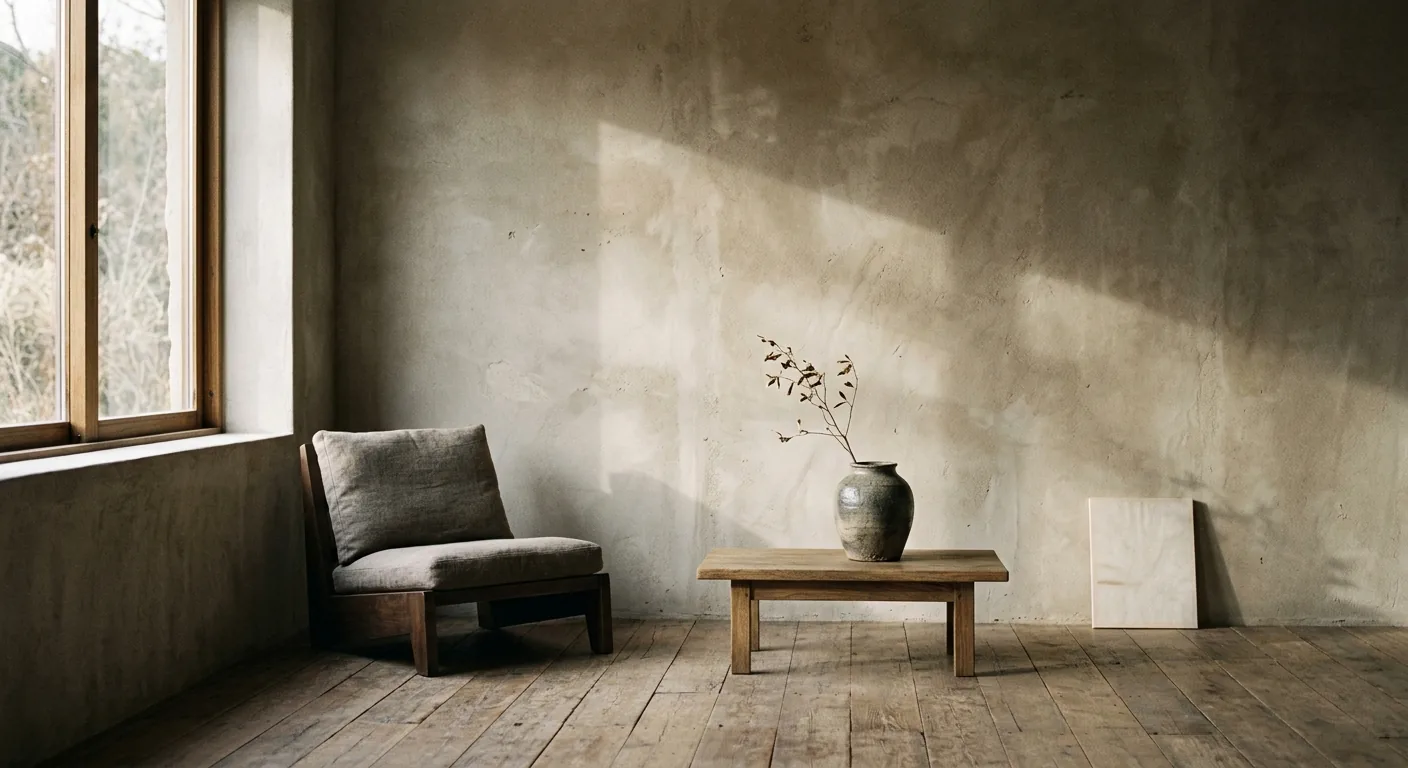
Caption: Wabi-Sabi living room - earth tones, micro-cement, natural wood, negative space, and natural side light
Key takeaway: Residential lighting design has a significant effect on residents' emotional wellbeing (ScienceDirect, 2022), and natural side light is exactly what gives Wabi-Sabi its signature shadow layering and sense of time - the biggest thing that sets it apart from ordinary minimalism.
Wabi-sabi originates from Japanese tea-ceremony aesthetics, and it appreciates "imperfection, impermanence, and rustic simplicity." It doesn't chase newness or gloss - instead, it treasures handmade marks and the texture and flaws of natural materials. In recent years it's moved from niche to mainstream, with Wabi-Sabi-related searches growing 90% in 2025 (Hackrea, 2025). In one line: Wabi-Sabi is the style that treats "the mark of time" as beauty itself.
"Wabi" points to a quiet contentment found in simplicity and stillness; "sabi" carries the beauty of time passing and all things fading. Put together, wabi-sabi describes a state of mind that finds peace within imperfection and impermanence. It shares a lineage with Japanese tea ceremony and Zen thought.
Brought into the home, that state of mind becomes a set of choices: not disguising a material's roughness, not chasing symmetry and precision, accepting that a ceramic bowl with a crack can still be beautiful. You're not decorating a show home - you're growing a home with warmth in it.
You can grasp Wabi-Sabi through three keywords. Imperfection - appreciating the irregularity of handmade objects and the natural flaws in materials, rather than chasing polish and newness. Rustic simplicity - using natural, understated materials, avoiding high saturation and anything that feels plastic. Negative space - deliberately leaving room so the few objects that remain have space to breathe.
These three ideas reinforce each other. Negative space lets rustic objects be seen; imperfection gives a space its human warmth. Without negative space, rustic simplicity turns into clutter; without rustic simplicity, negative space turns hollow.
Wabi-sabi is often confused with minimalism, but the two have a different character. Minimalism chases clean, crisp, and stripped-down - it's about line and order; Wabi-Sabi chases a sense of time and handmade warmth, and it allows irregularity and the marks of age. Minimalism is a cool-headed subtraction; Wabi-Sabi is a warm kind of negative space.
You can see it in the materials, too: minimalism favors glossy lacquer, glass, and metal, while Wabi-Sabi prefers textured natural materials like micro-cement, natural wood, and handmade clay. To compare Wabi-Sabi against other light-toned styles, see the breakdown in Japanese Minimalist Style.
Wabi-Sabi's look rests on three pillars: color, material, and light. The palette leans on earth tones, grays, and low saturation, avoiding high chroma; materials lean toward textured natural choices like micro-cement, natural wood, and handmade clay; and light relies on natural side lighting to bring out shadow layering. Research shows that residential lighting design has a significant effect on emotional wellbeing (ScienceDirect, 2022) - exactly why Wabi-Sabi places such weight on natural light.
Wabi-Sabi's palette is "the colors that grow out of the earth." Rice, camel, terracotta, taupe, deep green - these low-saturation earth tones form the backbone. They're calm, unassuming, and make a space feel like a photo dialed down one notch - settled and easy to look at over time.
Avoiding high saturation and strong contrast is key. The moment a bright, saturated color shows up, that sense of Zen calm gets interrupted. To get the Wabi-Sabi earth-tone ratio right, Room Color Schemes covers the underlying color principles.
Material is the soul of Wabi-Sabi, because it's what carries "the beauty of imperfection." Micro-cement's uneven texture, natural wood's grain and knots, and the handmade marks in clay pottery are all features kept deliberately, not polished away. These materials feel warm to the touch and look like they have a story.
Avoid glossy finishes, plastic feel, and anything that's over-polished - that will break the Wabi-Sabi mood instantly. My own rule when styling is: pick handmade over mass-produced whenever you can, and let the texture show rather than sealing it under a glossy coat.
The most captivating part of Wabi-Sabi is light and shadow. Natural side light casts soft shadows across micro-cement walls and natural wood furniture, letting a space shift and flow with the time of day. This "layering of light" is Wabi-Sabi's signature.
That's exactly why Wabi-Sabi is so dependent on natural light. A home with weak light forcing a Wabi-Sabi look tends to feel dim, even stuffy. Assess whether your home's natural light is sufficient before you start work - that matters earlier than which sofa to pick.
Wabi-Sabi can be brought into every room in the home, but each space has its own emphasis. The core principle stays the same: negative space, earth tones, natural materials, less is more. Give each room only the objects it truly needs, and let them have breathing distance between them - that's the general rule of Wabi-Sabi styling. Here's an actionable breakdown, room by room.
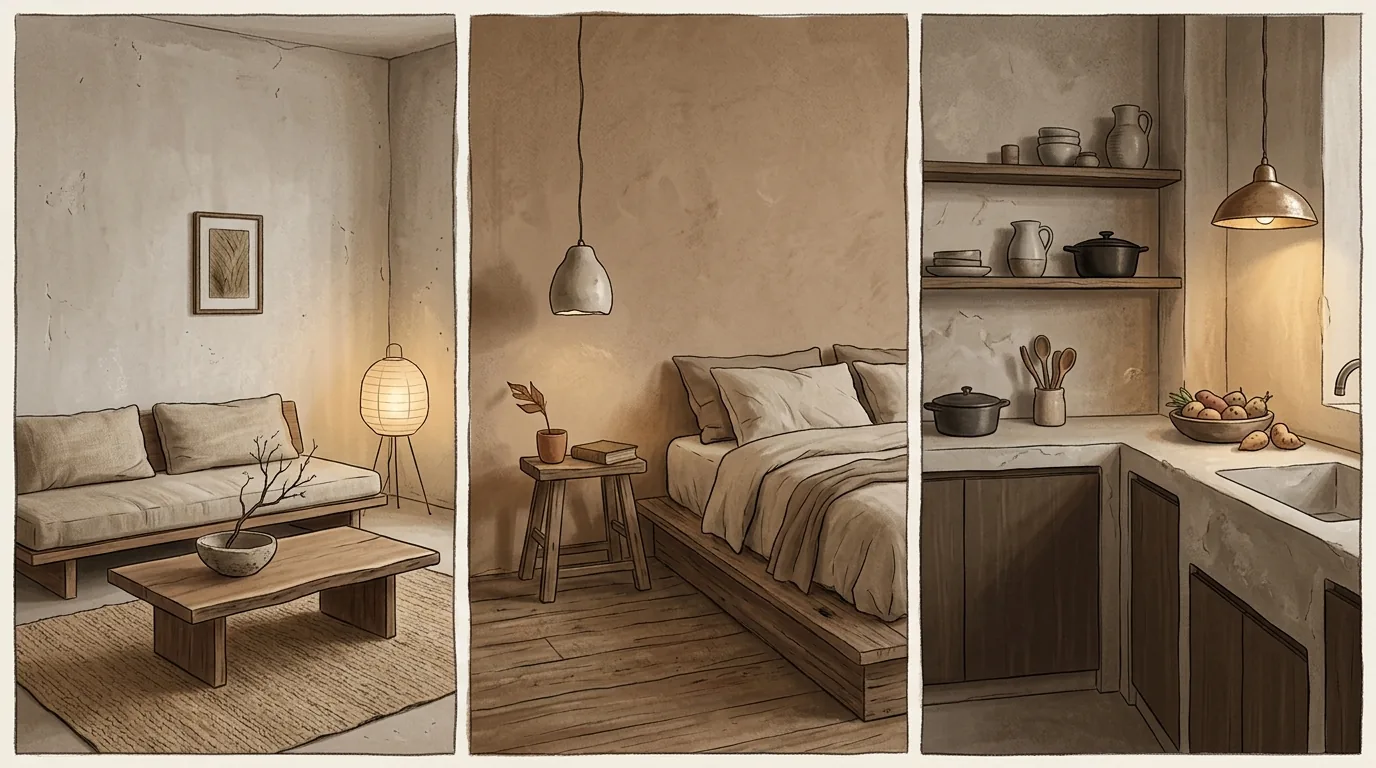
Caption: Wabi-Sabi room by room - negative space and low furniture in the living room, soft earth tones in the bedroom, micro-cement and matte finishes in the kitchen
The keyword for a Wabi-Sabi living room is restraint. Use low furniture to lower the visual weight and expand the sense of space, leave generous negative space on walls and floor, and keep only one statement piece in the whole room - a beautifully textured sofa or a single natural-wood chair - as the visual focal point. Scale every other accessory back to a minimum.
Don't fill up the living room. The biggest trap in a Wabi-Sabi living room is "not being able to let go" - every extra piece you add takes away a bit of the power of negative space. Negative space is the true star of a Wabi-Sabi living room. For a full living room layout plan, see The Complete Living Room Design Guide.
A Wabi-Sabi bedroom is built for rest, using soft earth tones and a minimal bed setup to create a sense of calm. Beige, camel, and pale taupe bedding, paired with a natural-wood bed frame and low-saturation walls, wrap the whole room in a gentle embrace. Low-chroma tones also help with relaxation (Costa et al., Frontiers in Psychology, 2018).
Avoid high contrast and elaborate headboard decoration. The bedroom is the most private space in the home - let it settle down, and your sleep quality will thank you for it. To plan your bed, wardrobe, and closet dimensions together, The Bedroom Design Guide is worth a read.
Kitchens and bathrooms are constrained by material and cleaning needs, but Wabi-Sabi can still work here. Micro-cement counters, matte tiles, and handle-free hidden edging keep the overall rustic tone intact while staying easy to clean. Avoid high-gloss finishes and flashy hardware, so even the functional spaces stay calm.
The key to a Wabi-Sabi kitchen is "concealment" - tuck appliances and clutter into matte cabinetry, leaving a clean countertop exposed. The bathroom, meanwhile, relies on micro-cement and earth-tone tiles to pull the wet zone into the same palette. To plan a wet-dry separated bathroom and its dimensions, see The Complete Bathroom Design Guide.
The ceiling is a spot that's easy to overlook in Wabi-Sabi, yet it adds a lot. Exposed structure and natural wood beams, paired with indirect lighting tucked along the beams or in wall corners, create soft, non-glaring light. Avoid large overhead fixtures and cool white light - those will break the warmth of Wabi-Sabi.
Indirect lighting is the key here. What Wabi-Sabi wants is "light with shadow in it," not every corner lit up equally. Leave a bit of dimness, and the space gains layers.
Wabi-Sabi decor has a clear direction: natural, tactile, understated. Pick natural wood, rattan, and pieces with tactile texture for furniture, avoiding gloss and plastic feel; layer in linen textiles, dried flowers, and handmade ceramics for soft furnishings. This section gives you a shoppable list to follow, plus inspiration for commercial spaces.
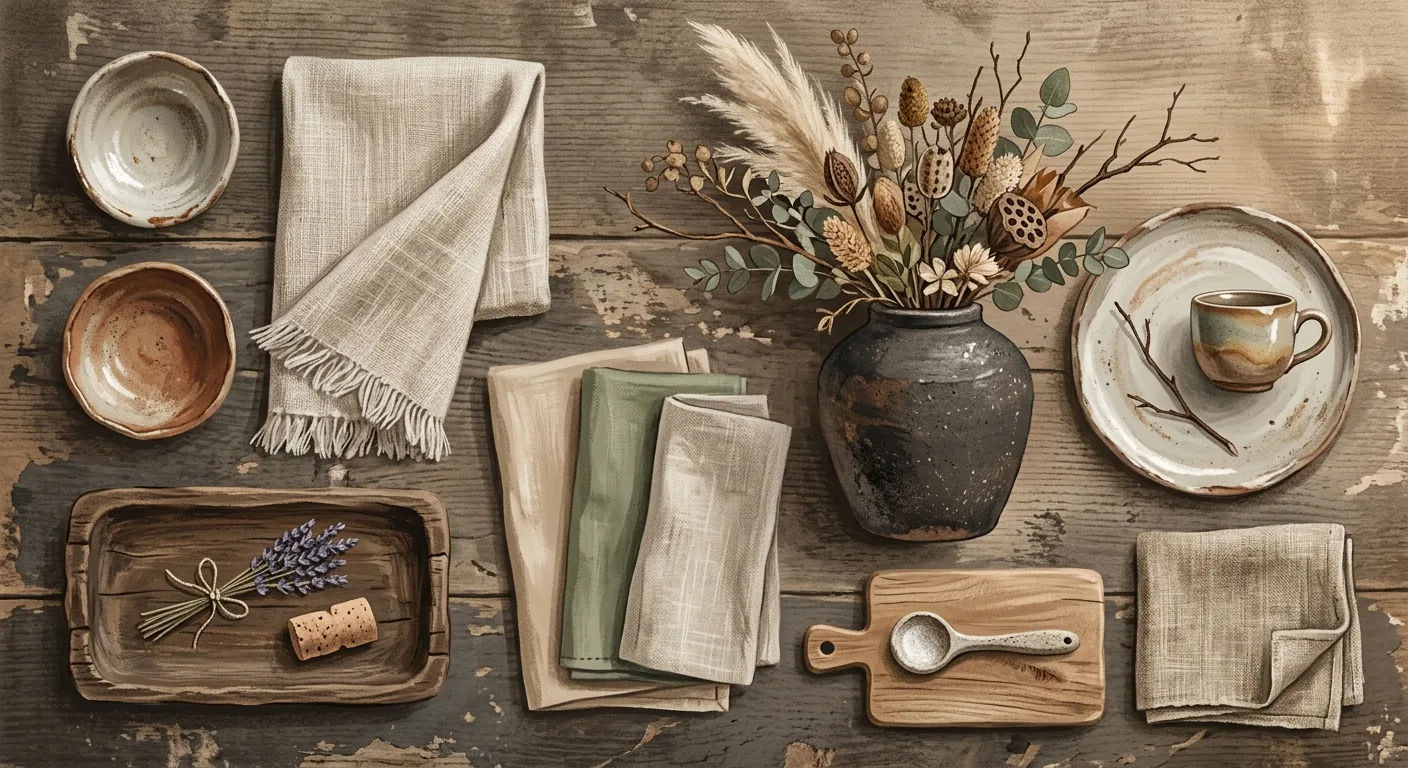
Caption: Wabi-Sabi decor picks - handmade ceramics, linen textiles, natural wood, dried flowers
The rule for choosing Wabi-Sabi furniture is "let the material itself show through." Natural wood furniture's grain and knots, rattan's handwoven texture, and the rustic, tactile feel of raw clay and stone are all Wabi-Sabi's preferred picks. Keep the lines as low and simple as possible, so furniture blends into the space rather than jumping out of it.
Avoid glossy lacquer, chrome metal, and anything that feels heavily plastic. In my own experience, one aged piece of wooden furniture with real history in it often carries more Wabi-Sabi feeling than an entire set of brand-new pieces.
Soft furnishings are the key to layering in Wabi-Sabi. The natural drape and wrinkle of linen and cotton-linen blends, the withered beauty of dried flowers, and the irregular edges of handmade ceramics all bring warmth into a space. String them together with a single earth-tone palette, and the layering comes together on its own.
The key is "less but well chosen." Wabi-Sabi soft furnishings aren't about piling up quantity - they're about selecting a handful of the right, storied objects. One bundle of dried flowers or one hand-thrown ceramic bowl beats a table full of knickknacks.
Wabi-Sabi style has become popular in guesthouses and storefronts in recent years, because it naturally carries an "Instagram-worthy atmosphere" and distinctiveness. Micro-cement walls, a long natural-wood table, earth-toned soft furnishings, plus deliberate negative space and side light, easily become a photo spot. Using Wabi-Sabi in a commercial space means taking care of "atmosphere" and "traffic flow" together.
That said, commercial spaces see heavy foot traffic, so Wabi-Sabi's negative space and light-toned materials need to account for staining and maintenance. To keep the atmosphere intact without blocking traffic flow, furniture sizing and spacing need to be calculated precisely first - that's what the next section digs into.
The most common complaint you'll see about Wabi-Sabi online is "did it wrong and it turned into a raw concrete shell." Wabi-Sabi looks casual, but it's actually very demanding when it comes to proportion and detail. Negative space isn't emptiness, rustic simplicity isn't clutter, and texture isn't coldness - cross any of these three lines and Wabi-Sabi falls apart. Here's a breakdown of the three most common myths.
Many people assume Wabi-Sabi just means "the less stuff, the better," and end up with an empty, pointless room. Real negative space has proportion and a focal point: it sets off the statement piece and gives the eye somewhere to land. A completely empty room isn't Wabi-Sabi - it's a room that hasn't been styled yet.
The trick to negative space is "leave room for what matters." Decide on the visual focal point first, then use negative space to bring it out. Have you ever wondered why some Wabi-Sabi spaces feel beautifully empty while others feel just cold? The difference comes down to whether there's a focal point.
Wabi-Sabi's low-saturation earth tones are easily misread as "anything matches, so it doesn't matter." In reality, rustic simplicity demands even more discipline: materials need to feel coherent, tones need to stay unified, and placement needs a sense of order. Low saturation doesn't give you license to pile things up randomly - if anything, it demands more restraint.
The difference between clutter and rustic simplicity comes down to "whether it's been chosen deliberately." Every object left in the room should have a reason to be there - that's the biggest difference between Wabi-Sabi and hoarding.
The biggest pitfall in Wabi-Sabi is ending up with a cold, raw concrete shell. Micro-cement walls and exposed structure alone, with no warm wood, soft textiles, or the marks of daily life, isn't Wabi-Sabi - it's an unfinished construction site. Warmth and a lived-in feel are the soul of Wabi-Sabi.
The way to add warmth back in is natural materials and warm light. Natural wood, linen, and warm indirect lighting can pull a cold, hard micro-cement surface back into a home with human warmth. For a warmer-toned contemporary style to compare against, see Modern Minimalist and Cream Style.
Wabi-Sabi is most vulnerable to overcrowding, because its beauty is built on the breathing room between negative space and furniture spacing. That's exactly why confirming your scale is correct matters more than buying materials or soft furnishings first. Traffic aisles, negative-space ratio, furniture spacing - these numbers decide whether living in a Wabi-Sabi home feels comfortable or cramped. Get the scale right first, and the materials you buy won't go to waste.
Wabi-Sabi's negative space isn't "whatever's left over" - it's a ratio you need to calculate up front. How much space furniture takes up versus how much is left empty: get that ratio wrong, and Wabi-Sabi collapses. Too full looks cluttered, too empty feels cold, and finding that just-right point in between takes planning ahead of time.
The problem is, it's hard to picture whether the negative space is enough just by looking at a floor plan. Plenty of people only realize after laying everything out that what they thought was "negative space" got swallowed up by furniture. This is where placing furniture with a tool first, rather than eyeballing it, gets you a far more accurate read.
Roomfit lets you upload your floor plan and drag furniture into your layout at true 1:1 scale, so you can see aisle width and negative-space ratio directly. The system also automatically labels the clearance between furniture pieces and between furniture and walls. You can confirm before you start work: if this sofa goes here, is there still enough negative space left for Wabi-Sabi?
Once the scale is right, go back and layer on the rustic micro-cement, natural wood, and soft furnishings - that way you won't end up buying a pile of materials that don't fit into that "just right" spot. Place first, then look for beauty - that's the most practical order for bringing Wabi-Sabi to life. After reading through Wabi-Sabi, don't forget to go back to The Interior Design Styles Overview to see how it pairs with other styles.
Wabi-Sabi isn't aloof Japanese minimalism - it's a life philosophy that appreciates imperfection and embraces the mark of time. Master the three core ideas - imperfection, rustic simplicity, negative space - lay them out with earth tones, micro-cement, natural wood, and natural side light, then style room by room, and you can bring Wabi-Sabi into the living room, bedroom, kitchen, and bathroom.
Remember to avoid three pitfalls: don't let negative space go empty, don't let rustic simplicity go cluttered, and don't turn Wabi-Sabi into a raw concrete shell. And before layering on materials, use Roomfit to place furniture at 1:1 scale into your layout first, confirming the negative-space ratio and that aisles are wide enough. Get the scale right, and rustic materials can finally build the breathing room Wabi-Sabi is really about.
Wabi-Sabi originates from Japanese tea-ceremony aesthetics and appreciates imperfection, impermanence, and rustic beauty, with imperfection, rustic simplicity, and negative space as its three core ideas. Its biggest difference from minimalism: minimalism chases a clean, crisp subtraction and order, while Wabi-Sabi chases a sense of time and handmade warmth, allowing irregularity and the marks of age. Materially, minimalism favors smooth glass and metal, while Wabi-Sabi prefers textured natural materials like micro-cement, natural wood, and handmade clay - it's warm negative space rather than a cool-headed subtraction.
Yes, but you need to control the negative-space ratio and furniture count more strictly. Wabi-Sabi's beauty is built on negative space, and a small space already has limited room to begin with, so you need to be even more selective about every piece of furniture, lower the visual weight, and use low furniture to expand the sense of space. It's best to keep just one statement piece and scale everything else back to a minimum. Taiwanese homes tend to run compact, so before you start work, place furniture at 1:1 scale to confirm there's enough negative space - otherwise you may find the space swallowed up and Wabi-Sabi impossible to achieve.
Wabi-Sabi is very dependent on natural light, so a home with weak light will be harder to work with. Wabi-Sabi's soul is the shadow layering created by natural side light, and research also shows that residential lighting design has a significant effect on emotional wellbeing (ScienceDirect, 2022). A home with weak light forcing a Wabi-Sabi look tends to feel dim and stuffy. If your light is limited, raise the brightness of your earth-tone walls, use warm indirect lighting to add layering, and avoid large areas of dark color so the space doesn't turn too dim.
The principle is natural, tactile, understated. Pick natural wood and rattan furniture with tactile texture, low and simple in line, and avoid glossy lacquer and plastic feel; for soft furnishings, use linen and cotton-linen textiles, dried flowers, and handmade ceramics, strung together with a single earth-tone palette. The key is less but well chosen - a handful of storied objects beats piling up quantity. One aged piece of wooden furniture with real history often carries more Wabi-Sabi feeling than an entire set of new pieces, and that's the biggest difference between Wabi-Sabi and hoarding.
Arrange furniture in your space at true 1:1 scale with Roomfit and see exactly how much walkway is left — no install, no sign-up.
Start with Roomfit →