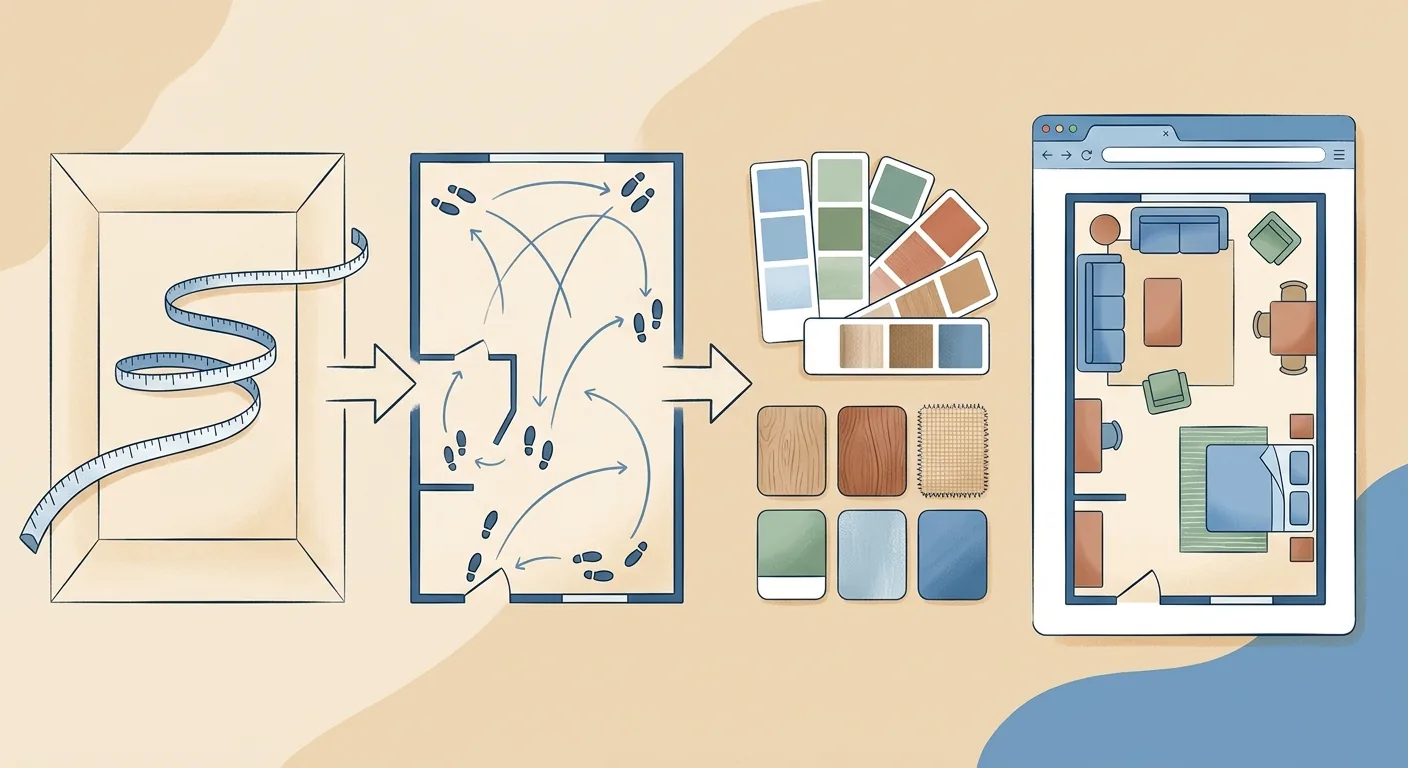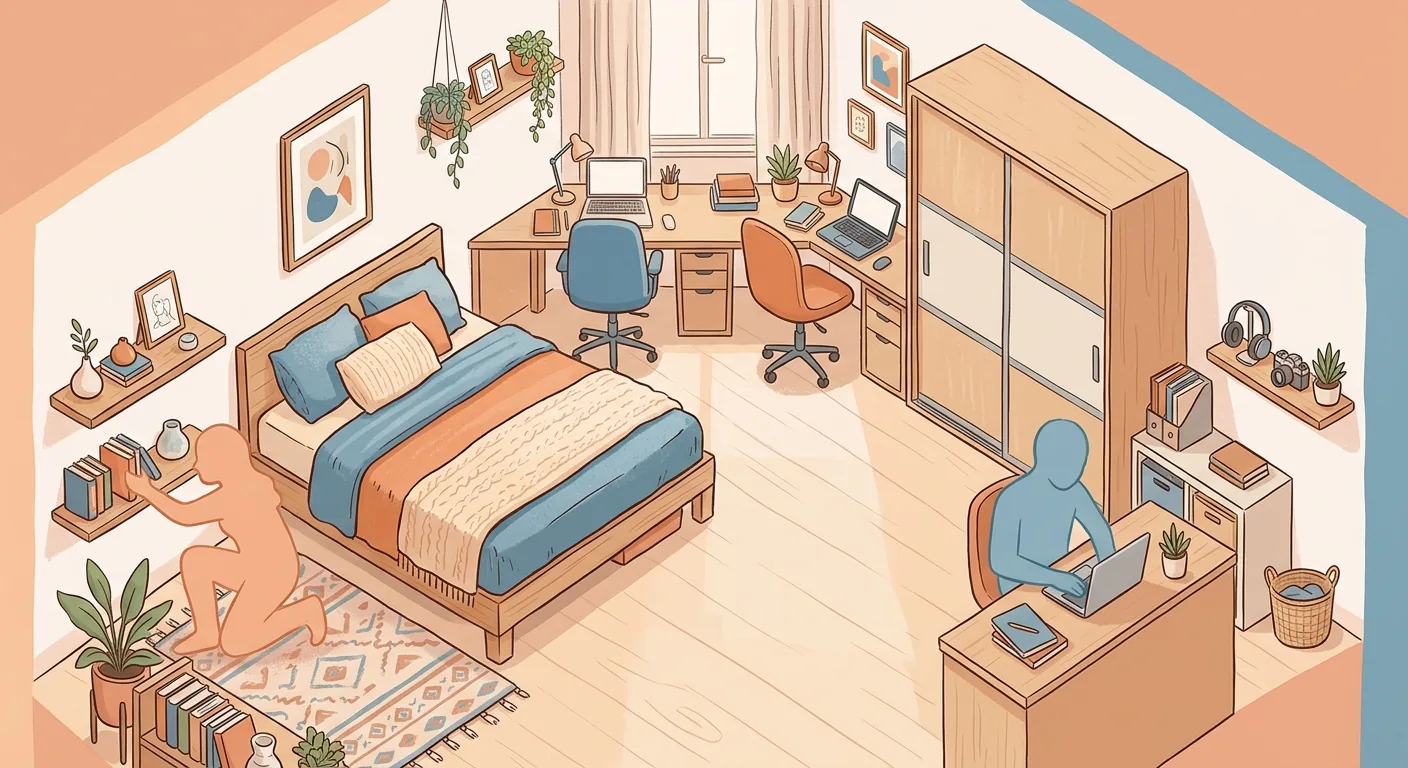

Two people sharing one room means more than just an extra bed — it means a whole set of daily habits that need reconciling. Different schedules, double the belongings, less personal space — a lot of couples don't start arguing until after they've already moved in.
Most of these frictions can actually be prevented at the styling stage. This piece will help you align on both of your needs first, then use a tool to lay out the clearances and aisles around the bed, a shared desk for two, and a shared wardrobe, before covering how to negotiate a shared style and storage zoning. The core idea in one line: get the placement right first, then move in together.
Caption: Three keys to a small space for two — both sides of the bed should be easy to get out of, each person keeps one private corner, and the aisle stays clear of furniture clutter
Key takeaway: Roughly 15.6% of households in Taiwan rent (per Directorate-General of Budget, Accounting and Statistics 2024 figures, with an 84.4% homeownership rate), and a good number of them are couples renting together. When two people share a small room, aligning on daily routines and personal-space needs first, then laying out clearances and aisles clearly, dramatically reduces the friction that comes after moving in together.
1Before Renting as a Couple: Align on Daily Routines and Personal-Space Needs First
The Directorate-General of Budget, Accounting and Statistics household survey shows Taiwan's homeownership rate stood at 84.4% at the end of 2024, meaning roughly 15.6% of households rent (Directorate-General of Budget, Accounting and Statistics, 2024). Among renters, couples sharing a lease to split rent is common. But living as two comes with an extra layer of homework compared to living alone: routines, traffic flow, personal space all need to be settled beforehand, or styling will lead straight to arguments after you've already moved in.
Align on needs first, then move into styling. Don't do it the other way around.
Align on Routines and Traffic Flow First
One of you goes to bed early and rises early, the other works late into the night — this kind of routine mismatch directly affects your styling. Whose desk should sit farther from the bed, how to zone the lighting, how to arrange the sleeping area — all of this needs to be settled up front. Whoever works from home needs a desk that won't be disturbed; whoever's out and about often needs a convenient entryway storage spot. Lay both of your routines out on the table, and the traffic flow will come out right.
Keep One Private Corner Each
Even sharing one room, each of you should keep a corner that's "your own." A dedicated desk, a dedicated storage compartment, a shelf that's yours — this small space is the pressure valve for long-term cohabitation. Psychologically having "a place that's mine" cuts down friction between the two of you enormously. No matter how small the space, make room for it.
Turn Your Needs Into a List
List out each of your needs separately: how much storage you need, how big a desk, which side of the bed, which items are shared and which stay separate. Once the list is laid out, any conflicting needs become obvious, making it much easier to reconcile them at the styling stage. Making the list is the first step in styling for couples — and the step most often skipped.
2Using Roomfit to Lay Out a Two-Person Room: Clearances and Aisles for the Bed, Shared Desk, and Wardrobe
Ministry of the Interior real estate data for the first half of 2025 shows small urban studios and single rooms are the dominant rental type (Ministry of the Interior Real Estate Information Platform, 2025). Squeeze two people's worth of furniture into a small room, and aisles and clearances need to be calculated even more carefully beforehand. Relying on imagination makes it easy to overcrowd the space — you won't find out until you're moving in that you can barely turn around.
Lay your room out in Roomfit, drag in a true-to-scale double bed, side-by-side desks, and a shared wardrobe, and the system will instantly mark the aisles on both sides and the door-swing clearance.
Both Sides of the Bed Should Be Easy to Get Out Of
For two people sharing a bed, it's best if both sides have a clear path to get out. If one side is against the wall, the person on the inside has to climb over their partner every single time they get up — which gets exhausting fast over the long run. Here's an ergonomics reference for a two-person room (not a mandatory code requirement — adjust for body size):
| Location | Recommended Clearance | Why |
|---|---|---|
| Getting-out-of-bed path on both sides | 50–60 cm each | Both people can comfortably sit up and get out of bed |
| In front of wardrobe/drawers | 75–90 cm | Room to open the door, pull out drawers, and bend down |
| Behind a shared desk | At least 60 cm | Room to push back the chair and stand up without hitting the wall |
Clearance Between the Shared Desk and Wardrobe
Storage for two people is the most likely thing to end up "the cabinet door won't open." A shared wardrobe needs 75 to 90 cm of clearance in front to open the door and bend down to reach in; a side-by-side desk needs room behind it to push back a chair, or the chair will hit the wall or the other person the moment it's pulled out. These clearances are obvious at a glance on screen — finding out on-site is already too late.
Plan Together With Collaborative Editing
The two of you can use a shared room code and lay out the same room together at the same time. "I want it here, you want it there" gets sorted out on screen before the furniture ever gets moved in, instead of arguing over it later. We've seen plenty of couples get stuck in real life arguing over "should the TV go on this wall, which way should the desk face" — switch to laying it out together on the same screen first, and it usually gets resolved fast.
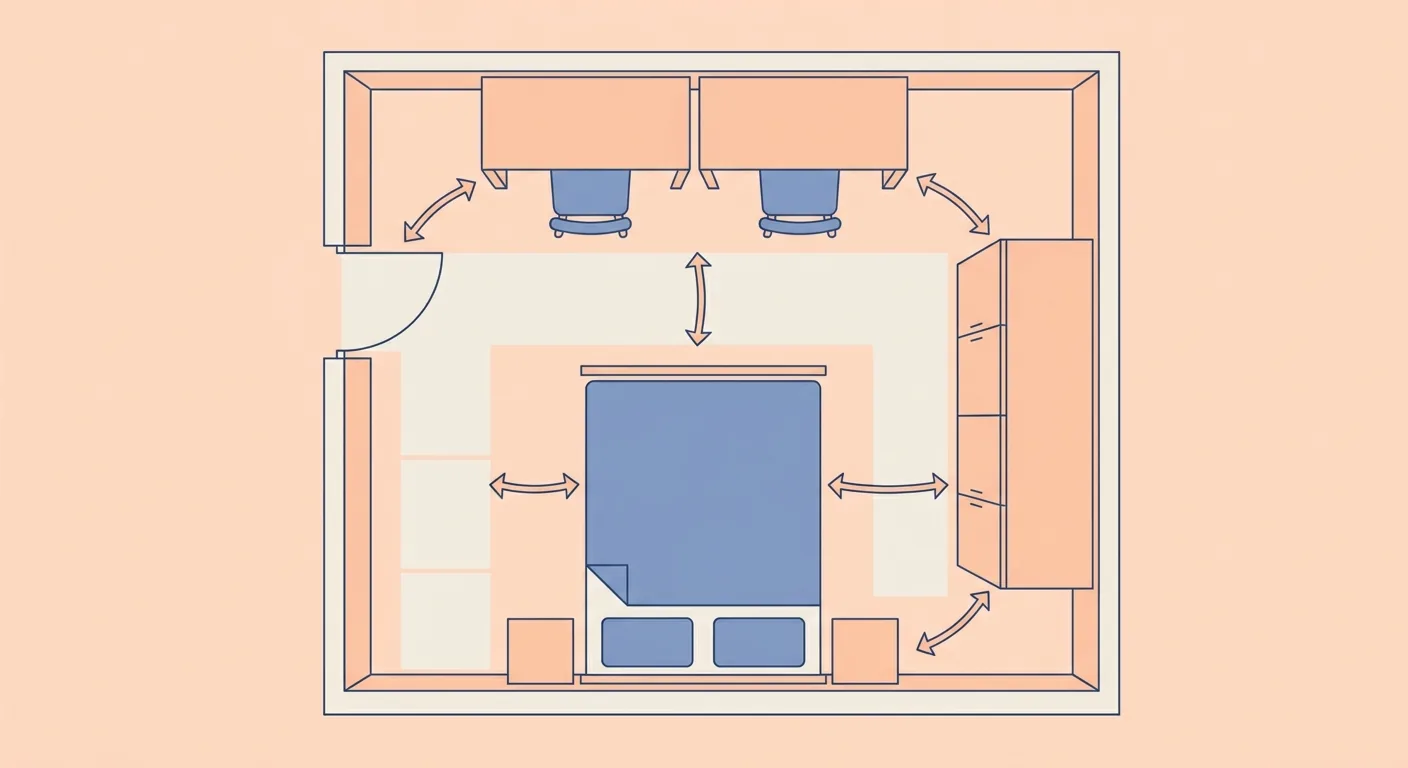
Caption: Clearance guidelines for a two-person room — 50–60 cm on each side of the bed, 75–90 cm in front of the wardrobe, and room to push back the chair behind a shared desk
3Couple Rental Styling Inspiration: Negotiating a Shared Style and Storage Zoning
According to the Taipei City DGBAS household survey, housing-related spending accounted for 28.49% of household consumption in 2024, the single largest category (Taipei City DGBAS, 2024). While two people sharing a lease splits the rent, storage needs double. When the two of you have different styles and storage habits, the key is to "divide zones first, then unify the tone" — rather than forcing everything to match.
Draw the lines clearly first, and style becomes much easier to negotiate.
Divide Storage Into Zones First
Zone your clothing and everyday items separately and label them clearly, keeping shared areas and personal areas distinct. Spelling out "this compartment is yours, that one's mine" reduces the everyday friction of "whose is this, who left this lying around." Zoning storage isn't about keeping score — it's the understanding that lets both of you actually feel comfortable. Shared items go in the shared zone, personal items go in each person's own compartment — simple, but effective.
How to Land on a Shared Style
Pick a main color and material tone that both of you can accept, and use that as the base for your shared style. Then let each of you decorate your own corner with the small items and art you like. This way you get a cohesive overall feel while still preserving each person's individuality. Style doesn't need to be 100% identical — nail the big direction, allow small differences, and it actually holds up better and is easier to live with.
Plan the Open/Close Clearances Together
Two people's worth of storage is the easiest thing to overpack. Plan the storage cabinet along with the clearance needed to open its drawers and doors into the tool together, to avoid a spot that "fits" on screen but can't actually be opened. If you want to plan a fuller cost-saving purchase strategy for two, check the money-splitting method in Budget Renter Styling Money-Saving Guide and put your budget toward furniture you'll both use.
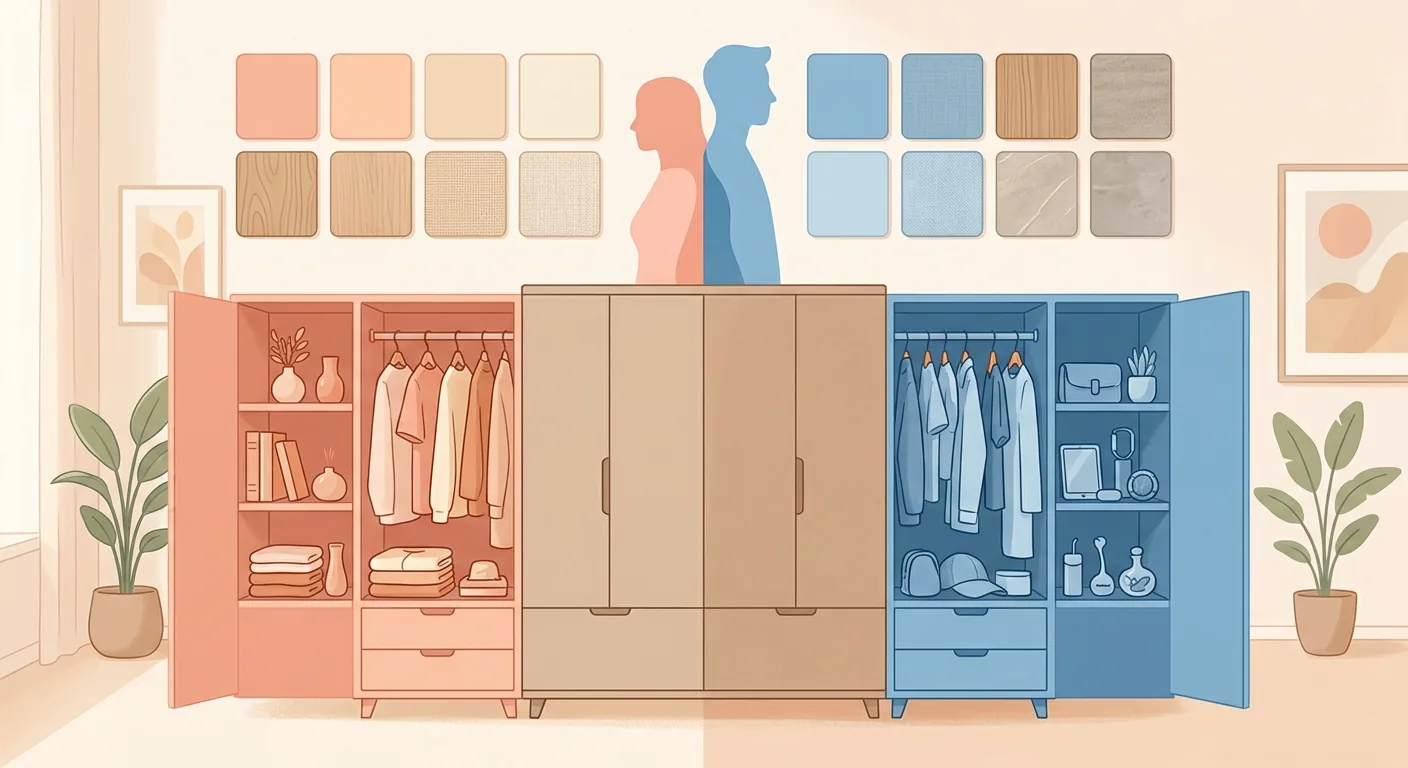
Caption: The zone-plus-unify method for two — put shared items in the shared zone, keep a private compartment for each person on either side, then pick one shared main color as your style base
4Real Cohabitation Experience From Dcard and PTT: Common Friction Points and Styling Pitfalls
The Consumer Protection Administration's 2023 review of 50 subleasing contracts found a 29.2% noncompliance rate (Consumer Protection Administration, 2023). That's also a reminder for couples renting together: who pays the deposit, who signs the lease, and how costs get split if you break up all need to be spelled out beforehand. Cohabitation friction discussions on forums can actually mostly be prevented with advance planning. Organizing these high-frequency topics is more useful than scrolling through every thread yourself.
Below, we've distilled friction points and styling pitfalls into actionable reminders.
How to Prevent Common Friction
Uneven division of chores, routines interfering with each other, insufficient personal space — these are the most common cohabitation frictions discussed on forums. How do you prevent them ahead of time? Draw the lines through styling and zoning first: each person's corner, each person's storage, and shared rules. Get the physical space sorted out clearly, and you've removed one reason to argue emotionally. Most friction happens because nobody talked it through beforehand.
Styling Pitfall Checklist
A room packed too full with no aisle left, storage that isn't enough for two people, no personal space of your own — these are the most common pitfalls in couple styling. The solution always points to the same thing: plan before you move in. Lay out both of your furniture on screen once, and whether the aisle, storage, and personal corners are enough becomes obvious at a glance. Couples with strict landlords who can't drill into walls can also check Decorating a Rental Without Damaging It for how to zone using placement alone. Putting couple styling back into the overarching principle of "measure first, plan first, then move in together" is exactly the core of Rental Styling Complete Guide.
5Living Together: Get the Placement Right First, Then Move In
Couple rental styling, at the end of the day, comes down to aligning first, then placing things right. Align on routines, personal space, and storage needs first, then lay out the clearances and aisles for the bed, desk, and wardrobe, and finally negotiate a shared style and zoning. Follow this order, and both of you can each get what you need even in a small shared room.
Get the placement right first, then move in together — this one sentence saves you from countless "I wish we'd talked about this beforehand" arguments. Laying out the same room together on one screen is the first lesson in cohabitation harmony. To understand the full logic of getting the placement right before focusing on looks, don't miss Rental Styling Complete Guide; couples renting together for the first time can also check The Complete Guide to Student Rental Setup and Precautions.
6FAQ
What should couples watch out for when renting together?
Align on needs first, then move into styling. Routines, personal space, and storage habits need to be spelled out beforehand to avoid friction after moving in. Roughly 15.6% of households in Taiwan rent (per 2024 Directorate-General of Budget, Accounting and Statistics figures), and couples sharing a lease to split rent is common, but living as two comes with an extra layer of homework. Listing out both of your needs, keeping one private corner each, and laying out clearances and aisles clearly beforehand are the three most effective steps for reducing cohabitation friction.
How do you lay out a two-person room without it feeling cramped?
The key is clearance. A reference ergonomics guideline for a two-person room: 50 to 60 cm of getting-out-of-bed clearance on each side of the bed, 75 to 90 cm in front of a shared wardrobe, and room to push back the chair behind a shared desk (not a mandatory code requirement — adjust for body size). Small urban studios are the dominant rental type (per Ministry of the Interior first-half 2025 data), so two people's worth of furniture should be laid out on screen first to confirm the aisle is wide enough and cabinet doors open freely, before moving anything in.
How should couples divide up storage and personal space when living together?
Divide into zones first, then unify the style. Zone clothing and everyday items separately and label them clearly, keeping shared and personal areas distinct, to reduce the friction of "whose is this." For a shared style, pick one main color tone that both of you can accept, then let each person decorate their own corner with items they like. Even sharing one room, keep a dedicated corner for each person — it's the pressure valve for long-term cohabitation, and worth making room for no matter how small the space.
Who should pay the deposit and sign the lease when a couple rents together?
Be sure to spell this out in writing beforehand. The Consumer Protection Administration's 2023 review of subleasing contracts found a noncompliance rate as high as 29.2%, showing that lease details are often overlooked. We recommend clearly stating who pays the deposit, how the split works, whose name is on the lease, and what happens if you break the lease early or break up. Under Ministry of the Interior regulations, a deposit cannot exceed two months' rent. Actual rights and obligations are governed by your lease terms and local law.
7Related Reading
- Double Bed Size Chart: Standard, Queen, and King Dimensions
- Wardrobe Size Chart and Design Recommendations
- Furniture Layout and Partition Design for a One-Bedroom Apartment