The sofa's bought, the TV's mounted, the coffee table's in place — and yet the living room still feels somehow off. It's usually not that the furniture is bad — it's that the "proportions" aren't right. A distance that's off by 30 cm, a coffee table one size too big, and the whole space stops feeling effortless.
This article lays out the three numbers that determine whether a living room actually works well: how far the sofa should be from the TV, how close it should sit to the coffee table, and how tall and long that coffee table should be to match. Everything's organized into a quick-reference chart, along with viewing distances for each TV size. If you want to check the dimensions of the sofa and TV cabinet themselves first, head back to the complete furniture dimensions chart hub page before digging further.
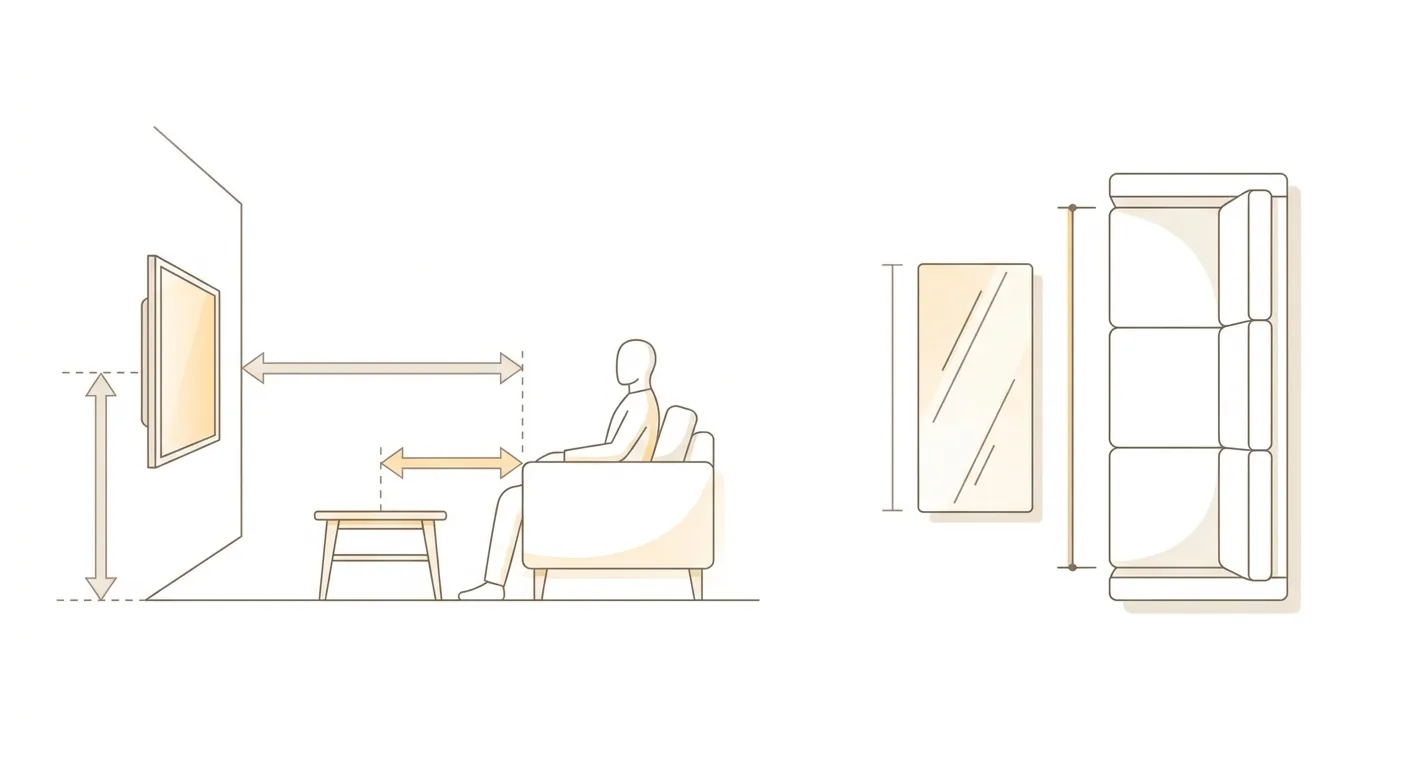
Caption: The living room's three golden ratios — sofa-to-TV distance, sofa-to-coffee-table distance, and a coffee table length about two-thirds of the sofa's width
Key takeaway: The most comfortable viewing angle for a TV is roughly 30 degrees per SMPTE, and 36–40 degrees per THX (Optimum HDTV viewing distance, Wikipedia); leave 30–45 cm from the sofa's front edge to the coffee table. These are general comfort and aesthetic ratios, not regulations, and can be adjusted to your habits.
1Living Room Golden Ratio Quick Reference: Distance and Height for Sofa, Coffee Table, and TV
What makes a living room work comes down to three numbers. OSHA's ergonomic guidance for computer monitors recommends the screen center sit 15–20 degrees below eye level when seated (OSHA Computer Workstations eTool, verified 2026); applied to watching TV, that means the screen center should sit level with or slightly below your seated eye line, working out to roughly 100–110 cm off the floor. The quick-reference chart below organizes the distance and height for sofa, coffee table, and TV all at once — use it as your master layout guide.
| Relationship | Recommended Value | Notes |
|---|---|---|
| Sofa front edge ↔ TV | Roughly 1.4–3.0 meters, depending on size | See size chart below |
| Sofa front edge ↔ coffee table | 30–45 cm | Sweet spot for resting feet / moving |
| Coffee table height ↔ sofa seat height | Similar, or 0–10 cm lower | Seat height 40–45 → coffee table 40–45 |
| Coffee table length ↔ sofa width | About two-thirds (0.6–0.7x) | 210 cm three-seat sofa → 120–140 cm table |
| TV screen center height off floor | About 100–110 cm | Level with seated eye line |
Three Key Distances and Heights, at a Glance
The first is sofa to TV, which determines how comfortable viewing is and scales with TV size. The second is sofa to coffee table — 30–45 cm is the sweet spot for resting your feet and reaching for things. The third is height — coffee table height matched to sofa seat height, and TV screen center matched to seated eye line. Get all three right, and the living room just works.
How and Where to Measure From
Measure consistently, or the numbers will get scrambled. Both sofa-to-TV and sofa-to-coffee-table should be measured horizontally from the "sofa's front edge" to the target, not from the backrest. Height should be measured from the floor to the tabletop, and from the floor to the screen center. When we help users check their floor plans, the most common mistake is measuring from the sofa's backrest to the TV, which adds an extra seat depth (roughly 55–60 cm) and throws the whole distance off.
These Ratios Are Recommendations, Not Hard Rules
Every number here is a general comfort and aesthetic recommendation, and you can adjust it to your own habits — if you like propping your feet up, lean the coffee table distance toward 45 cm; if you move around a lot, leave the walkway side a bit wider. Keep this separate from "safety clearance / walkway regulations," which are hard rules and a different matter entirely — see our furniture clearance and safety distance guide for that. Treat the ratios as a rough starting point, then adjust to your actual space — that's the correct way to use them. Does your own living room have its own comfort sweet spot? To get your whole living room's furniture placed right before worrying about how it looks, pair this with our complete furniture placement simulation guide.
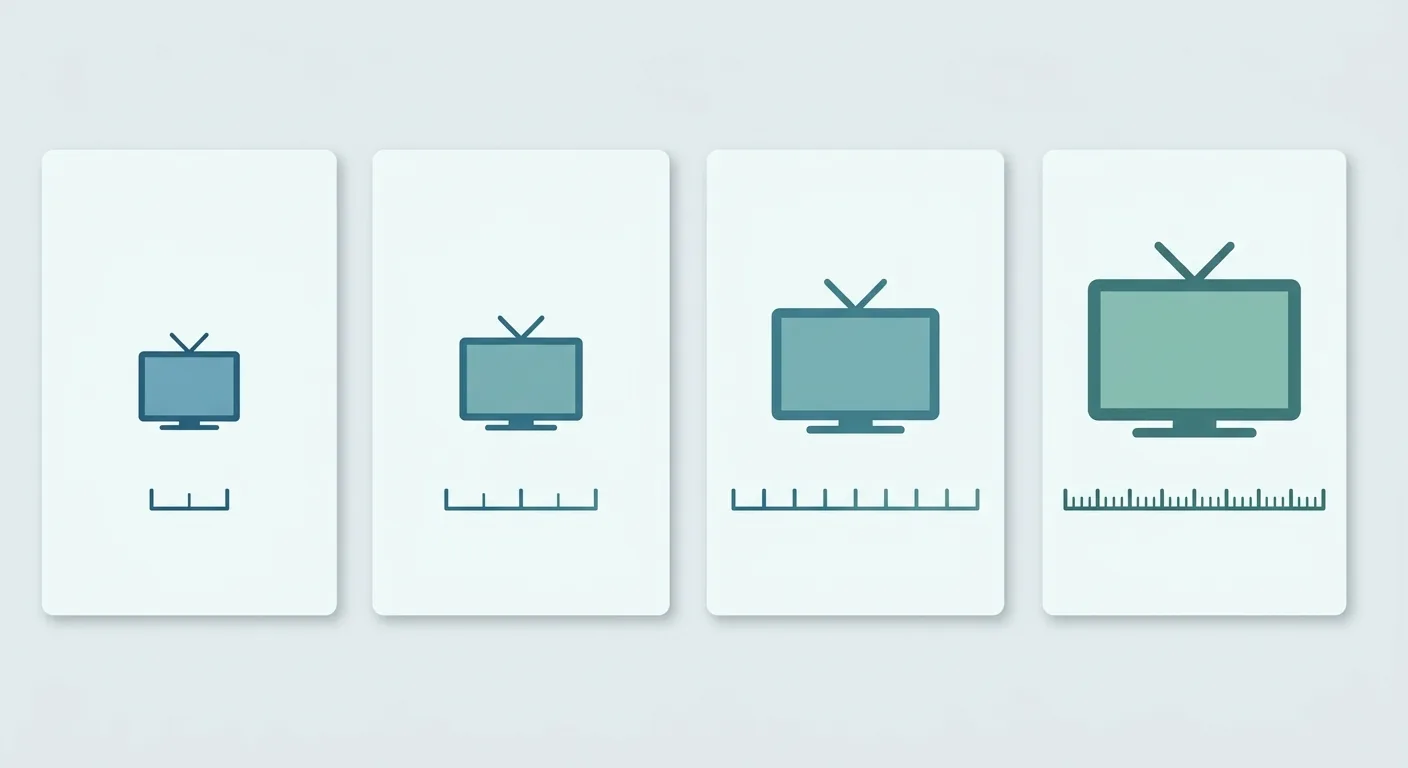
Caption: The bigger the TV, the farther back the sofa should sit — roughly 1.1–1.7 m for 43", 1.4–2.2 m for 55", 1.6–2.6 m for 65", and 1.9–3.0 m for 75"
2How Far Should the Sofa Be from the TV? Comfortable Viewing Distance by TV Size
How far depends on how many inches your TV is. Comfortable viewing distance scales with size: combining SMPTE's roughly 30-degree guidance and THX's 36–40-degree guidance (Optimum HDTV viewing distance, Wikipedia; THX Viewing Guide), a 43-inch TV calls for roughly 1.1–1.7 meters, 55-inch roughly 1.4–2.2 meters, 65-inch roughly 1.6–2.6 meters, and 75-inch roughly 1.9–3.0 meters. If you're unsure, take the middle of the range and adjust based on your actual room.
Matching TV Size to Viewing Distance
The bigger the TV, the farther the distance — a straightforward linear relationship. You can copy the numbers above directly: a small living room pairs well with a 55-inch TV at 1.4–2.2 meters; a large living room going for 75 inches should pull back to 1.9–3.0 meters so the screen doesn't fill your entire field of view. For pairing the TV cabinet with your TV size, see the TV cabinet and desk dimensions chart.
Why 4K Lets You Sit Closer
Because you can no longer see the pixels. Higher-resolution 4K content has a comfortable viewing distance of roughly 0.8 times the screen's diagonal at the same size — closer than 1080p without the image looking grainy (Optimum HDTV viewing distance, Wikipedia). So when watching 4K content, you can lean toward the closer end of the range on the same TV, for a more immersive picture.
The Difference Between Sitting Too Close and Too Far
Too close, and your eyes tire quickly, with a viewing angle so wide you have to turn your head to see the edges; too far, and details blur, subtitles become hard to read. We tested this ourselves on a 1:1 canvas, pulling a 55-inch TV's distance from the sofa from 1.4 to 2.2 meters — 1.4 meters felt more cinematic, 2.2 meters was easier for watching sports, and 1.8 meters in the middle worked best across the board. Most people overlook one thing: for the same TV, if you mostly watch movies, take the closer value (more immersive); if you mostly watch news or sports, take the farther value (easier to see the whole picture) — the distance can actually be tailored to whatever you watch most, rather than following one single standard answer.
3How Should Sofa-to-Coffee-Table Distance and Coffee Table Height Be Configured? The Sweet Spot for Moving and Reaching
Sofa seat height is mostly in the 40–45 cm range (a general furniture standard), and the coffee table should follow that height. OSHA's ergonomic guidance stresses that the body should stay upright and elbows relaxed when reaching for something (OSHA Computer Workstations eTool) — applied to the living room, that means a coffee table height close to seat height makes reaching for a cup natural rather than awkward. Distance-wise, leaving 30–45 cm from the sofa's front edge to the coffee table is the sweet spot for moving and reaching.
30–45 cm from Sofa's Front Edge to Coffee Table
Too close and you can't stretch your legs out; too far and you have to stand up to reach things. 30–45 cm hits the mark — you can stretch your legs out while seated, and still reach the coffee table with your hand. If your household is larger or moves around a lot, lean toward 45 cm to leave more room for passing through.
The Gap Between Coffee Table Height and Sofa Seat Height
Coffee table height should be close to sofa seat height, or 0–10 cm lower. At a seat height of 40–45 cm, set the coffee table to 40–45 cm as well. That way, setting down a cup or picking something up doesn't require lifting or bending your hand — the most natural setup. A coffee table that's too tall blocks your sightline and is hard to reach — worth watching for when choosing a style.
Coffee Table Depth and Walking Around It
Coffee table depth is mostly in the 40–60 cm range. If one side of the coffee table also doubles as a walkway, factor in the walkway's clear width too — the sweet spot for resting your feet is 30–45 cm, but if you need to actually "walk through," you'll want at least 60 cm for it to feel comfortable. For this kind of trade-off between walkway and clearance, see our furniture clearance and safety distance guide for the full comparison.
4How Do You Size the Sofa-to-Coffee-Table Ratio? The Recommended Ratio of Coffee Table Length to Sofa Width
There's an easy-to-remember ratio here. The core rule: coffee table length should be about two-thirds of sofa width (0.6–0.7x). A three-seat sofa around 210 cm wide pairs with a coffee table of about 120–140 cm; a two-seat sofa around 150 cm wide pairs with a coffee table of about 90–100 cm — this ratio keeps things stable and visually balanced. This is a general design ratio for interior layouts, not a regulation, and can be adjusted to your style.
Coffee Table Length ≈ Sofa Width × Two-Thirds
A coffee table that's too long looks bulky and eats into the walkway; one that's too short can't visually support the sofa's presence. Two-thirds is the most visually pleasing ratio. We've dragged a three-seat sofa paired with coffee tables of different lengths into a 1:1 canvas to compare, and a 120–140 cm table looked the most balanced — dropping to 90 cm noticeably looked "a size too small." For how to measure the sofa itself and how wide it should be for each seat count, pair this with our complete sofa dimensions guide.
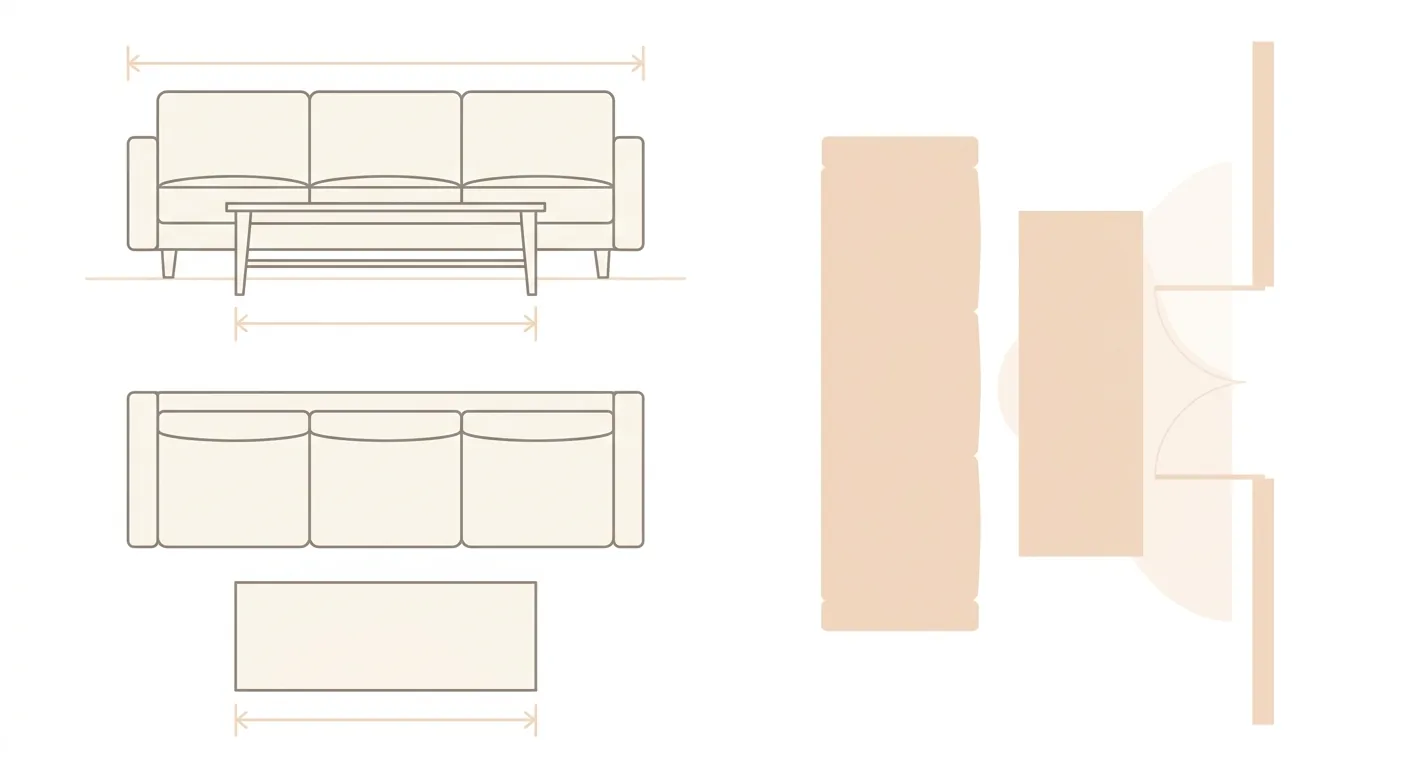
Caption: Coffee table length should be about two-thirds of sofa width (0.6–0.7x) — a 210 cm three-seat sofa pairs best with a 120–140 cm coffee table
Coffee Table Sizing for Three-Seat and L-Shaped Sofas
A three-seat sofa pairs perfectly with a long coffee table of 120–140 cm. For an L-shaped sofa, there's no need to force a single long table — a small square table, or two small tables used flexibly, works just as well and makes walking around it easier. The key is not letting the coffee table block the L-shape's corner traffic flow.
Verify the Ratio by Placing It in Your Living Room at 1:1 Scale
These ratios give you a sense of the numbers, but only your own living room's wall length and traffic flow tell you whether they actually work. Rather than guessing, drag the sofa, coffee table, and TV into your living room at true 1:1 scale and let the system automatically label all three distances so you can check the ratios in real time. Use Roomfit to place everything into your own layout at true 1:1 scale, get the layout right first, then worry about looking good, and verify it all in minutes — whether the ratios are right becomes obvious on the canvas. For how to plan the sofa, TV wall, and the whole living room's furniture layout, see our complete living room design and furniture layout guide.
5FAQ
How far should the sofa be from the TV for comfortable viewing?
It depends on your TV size. Comfortable viewing distance scales with size: roughly 1.1–1.7 meters for 43 inches, 1.4–2.2 meters for 55 inches, 1.6–2.6 meters for 65 inches, and 1.9–3.0 meters for 75 inches. This combines SMPTE's roughly 30-degree guidance and THX's 36–40-degree viewing-angle guidance. For 4K content, you can take the closer end of the range, since 4K lets you sit closer than 1080p without the image looking grainy. If you're unsure, take the middle of the range and adjust from there.
How much distance should you leave between the sofa and coffee table?
Leave 30–45 cm from the sofa's front edge to the coffee table — the sweet spot for resting your feet and reaching for things. Too close and you can't stretch your legs out; too far and you have to stand up to reach things. If your household is larger and moves around a lot, lean toward 45 cm. If one side of the coffee table also doubles as a walkway, widen that section to 60 cm or more for comfortable passage. These are general comfort recommendations, not regulations, and can be adjusted to your habits.
How tall should the coffee table be, and how does it pair with sofa seat height?
Coffee table height should be close to sofa seat height, or 0–10 cm lower. Sofa seat height is mostly 40–45 cm, so set the coffee table to 40–45 cm as well. That way, setting down a cup or picking something up doesn't require lifting or bending your hand — the most natural, comfortable setup. A coffee table that's too tall blocks your sightline and is hard to reach, so check it against seat height when choosing a style, not just how the coffee table looks on its own.
How do you size the sofa-to-coffee-table ratio? How long should the coffee table be?
The core ratio is that coffee table length should be about two-thirds of sofa width (0.6–0.7x). A three-seat sofa around 210 cm wide pairs with a coffee table of about 120–140 cm; a two-seat sofa around 150 cm wide pairs with about 90–100 cm. Too long looks bulky and eats into the walkway, too short can't visually support the sofa. For an L-shaped sofa, a small square table or two small tables used flexibly works well without forcing a single long table.
How high should the TV screen center be mounted?
We'd recommend mounting the TV screen center roughly 100–110 cm off the floor, level with or slightly below seated eye line. Since sofa seat height is mostly 40–45 cm, a seated person's eye line sits at roughly 110–120 cm off the floor. OSHA recommends the screen center sit 15–20 degrees below eye level — applied to watching TV, that means don't mount it too high; if anything, err slightly low. Mounting it too high causes neck strain over time, one of the most common proportion mistakes.
6References
- OSHA Computer Workstations eTool — Monitors (U.S. Occupational Safety and Health Administration, ergonomic guidance on monitor height and sightline)
- Optimum HDTV viewing distance — Wikipedia (summary of SMPTE/THX viewing-angle and distance guidance)
- THX Viewing Guide (TV viewing distance recommendations)
- Complete Furniture Dimensions Chart (hub page for this cluster)
- Complete Sofa Dimensions Guide
- TV Cabinet and Desk Dimensions Chart
- Furniture Clearance and Safety Distance Guide