A wardrobe finally gets built, and only then do you find a thick coat won't fit and the door won't close, or the hanger sits crooked and presses a crease into the front of your clothes — this almost always comes down to the same cause: the depth wasn't right. Wardrobe depth decides whether clothes can hang facing forward, and a 5 cm difference makes a huge difference in the result.
40, 45, or 50 cm? This is the single question most people get stuck on. This article uses a hanging rod and shelf reference to lay out exactly "what fits at each depth," tells you how to work around insufficient depth, covers how deep a soiled-garment cabinet or a heavy coat needs to be, and finally shows you how to place a hanging rod in Roomfit's (roomfit.app) 1:1 canvas so the system automatically marks the depth dimension chain for an instant check. For the full picture of wardrobe planning, see the System Cabinet / Wardrobe Planning Overview first.
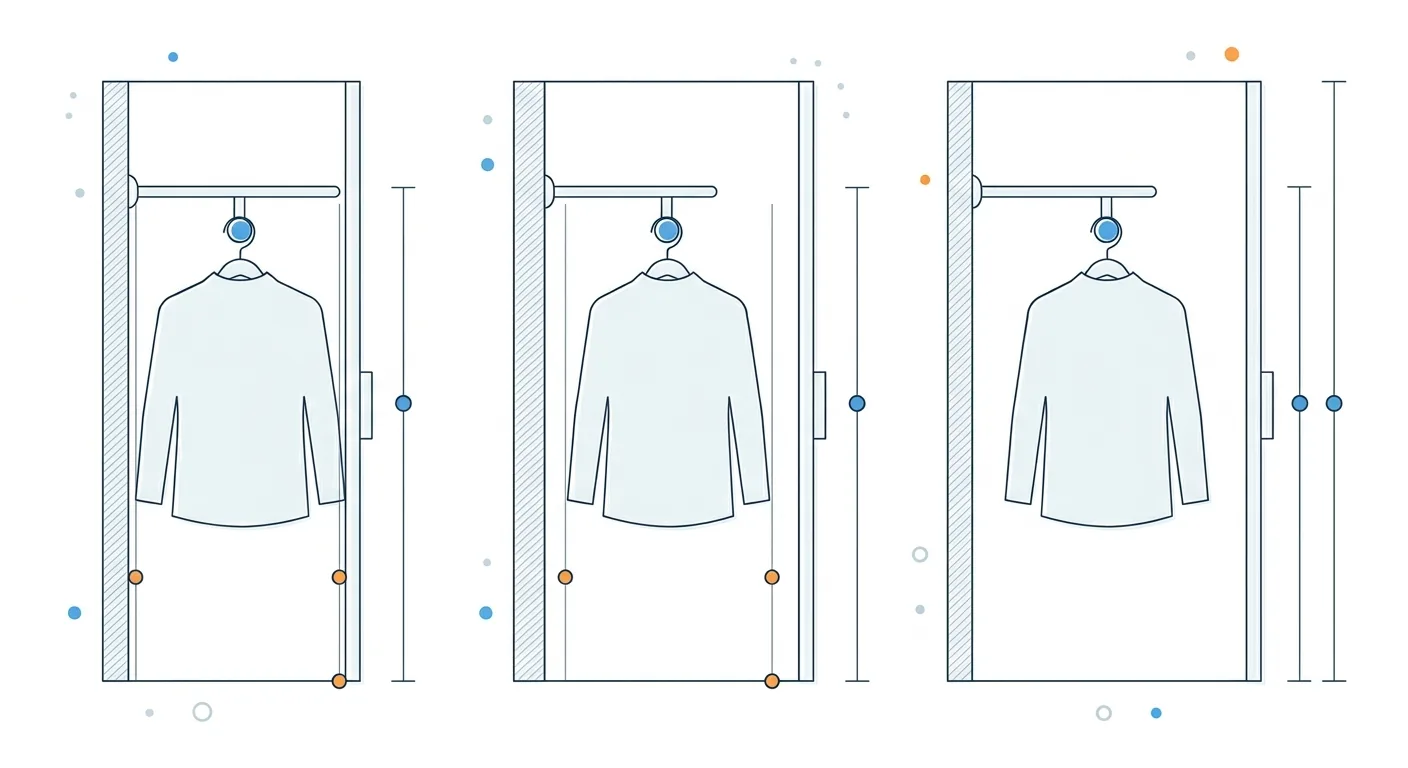
Caption: Side-by-side wardrobe depth comparison — at 40 cm clothes press against the door, 45 cm is a tight squeeze, 50 cm leaves a bit more slack, and 60 cm is the comfortable depth for hanging clothes facing forward (industry rules of thumb, verify with on-site measurement)
Key takeaway: Taiwanese homes keep getting smaller, with the average transacted floor area only about 31.5 ping (roughly 104 m²) in Q3 2025 (CNA, citing Ministry of the Interior statistics, 2026). The smaller the space, the more precisely depth needs to be sized: a standard plastic hanger has a shoulder width of about 42–45 cm, and for clothes to hang facing forward comfortably, the interior clear depth usually needs to be 55 cm or more.
1Standard Wardrobe Depth Values: What's the Difference Between 40/45/50 cm, and Who Are They For
The dividing line for wardrobe depth is "whether clothes can hang facing forward." A standard plastic hanger has a shoulder width of about 42–45 cm, and hanging clothes facing forward (the rod parallel to the wall, garments facing the door) — once you factor in fabric thickness and front-to-back clearance — usually needs 55–60 cm of depth to work comfortably (industry rule of thumb, verify with on-site measurement). A difference of a few centimeters completely changes how you have to hang things.
The conclusion up front: aim for 60 cm including the door panel if you want a comfortable forward hang. Below, we break down what each depth can actually do.
60 cm = the Standard Forward-Hang Depth (Including the Door Panel)
Taiwan's wardrobe industry most commonly treats 60 cm (including the door panel) as the standard forward-hang depth, with an interior clear depth of about 55–58 cm. At this depth, shirts, coats, and dresses can all hang facing forward without touching the door, and there's still some slack even when a hanger is turned at an angle. When you search "wardrobe depth recommendation" and see "60 cm," it's usually this outer-frame dimension, including the door panel, that's being referenced.
Why count the door panel in the total? Because the door, its hardware, and the clearance needed for clothes all eat into the depth. If you only look at the interior clear depth, the actual built cabinet ends up noticeably thicker — and in an awkward, tight space, that difference matters a lot.
What Can You Do With 50/45/40/35 cm?
| Depth (Including Door Panel) | Forward Hang | Best For |
|---|---|---|
| 60 cm | Yes, comfortable forward hang | Standard wardrobe depth, works for shirts, coats, and dresses |
| 50 cm | Marginal, tight forward hang | Thin clothes can hang forward, thick coats will hit the door |
| 45 cm | No, needs side hanging | Switch to a side-pull rod for side hanging, or use shelves |
| 40 cm | No, shelves only | Folding shelves, drawers, storage for thin items |
| 35 cm | No, shallow cabinet only | Soiled-garment cabinet, accessories, books, general items |
50 cm is an awkward depth — thin shirts can just barely hang forward, but a thick winter coat will hit the door the moment you hang it. Below 45 cm, forward hanging basically doesn't work, and you need to switch your approach. 40 and 35 cm can really only handle folding shelves, drawers, or thin-item storage. These specific values are exactly what searches like "wardrobe depth 45," "wardrobe depth 40," and "wardrobe depth 35" are really asking: at this depth, what can I actually use it for?
2Hanging-Rod Style vs. Folding Style: What Happens to Clothes When Depth Isn't Enough, and How to Fix It
Let's be clear first about what happens when "wardrobe depth isn't enough." When hanging clothes forward, hangers sit crooked, and the door won't close; even if you force it shut, the front of your clothes gets a crease pressed into it by the door. Wearing a crease out the door every day is a bad experience. So if the depth is already insufficient, do you have to tear it out and rebuild? No.
Depth is a fixed physical constraint, but there are three ways to work around it — the key is "choosing the right hanging, folding, or storage method for the depth you have," rather than forcing a forward hang regardless.
The Depth Needed for a Forward Hang (Rod Parallel to the Wall)
A forward hang means clothes face the cabinet door with the rod parallel to the wall — it's the easiest to reach into and find clothes in. The cost is that it demands the most depth: a hanger's shoulder width of 42–45 cm, plus fabric thickness and clearance, means it'll feel cramped without an interior clear depth of 55 cm or more.
So you'll find that whether you can hang forward is almost entirely a question of "is the depth enough." That's why depth is the first number to settle in wardrobe planning. To see where depth fits within the overall dimensions, the Wardrobe Standard Dimensions Chart has a full table covering width, height, and depth together.
Three Fixes for Insufficient Depth — a Side-Pull Extendable Rod, Switching to Folding Shelves, or Switching to Drawers
When depth isn't enough, pick one of these three fixes, or combine them:
- Switch to a side-pull extendable rod: Clothes face sideways instead, and even around 45 cm still works for hanging. The downside is you can only see the outermost garment at a glance, so finding clothes means pulling the rod out and flipping through.
- Switch to folding shelves: Set shelf spacing at 30–40 cm and fold shirts and knitwear onto them. Folding doesn't demand much depth, so even a shallow 40 cm cabinet can look great.
- Switch to drawers: Undergarments, socks, and accessories go into drawers, and 40 cm of depth works perfectly well.
We once helped divide up a shallow 45 cm cabinet, ending up with a side-pull rod for coats on the upper half and drawers for undergarments on the lower half — and it turned out more usable than forcing in a single forward-hanging rod. Insufficient depth isn't a dead end; it just pushes you to think more cleverly about your internal division.
3Depth for Special Needs: How Deep Should a Soiled-Garment Cabinet or a Heavy Coat Be
Not every garment needs 60 cm. The rule of thumb is simple: the thinner it is, the shallower; the bulkier it is, the deeper. A soiled-garment cabinet can be built quite shallow, while a coat cabinet needs to be built to full depth. Get the direction wrong and you either waste space or can't fit what you need.
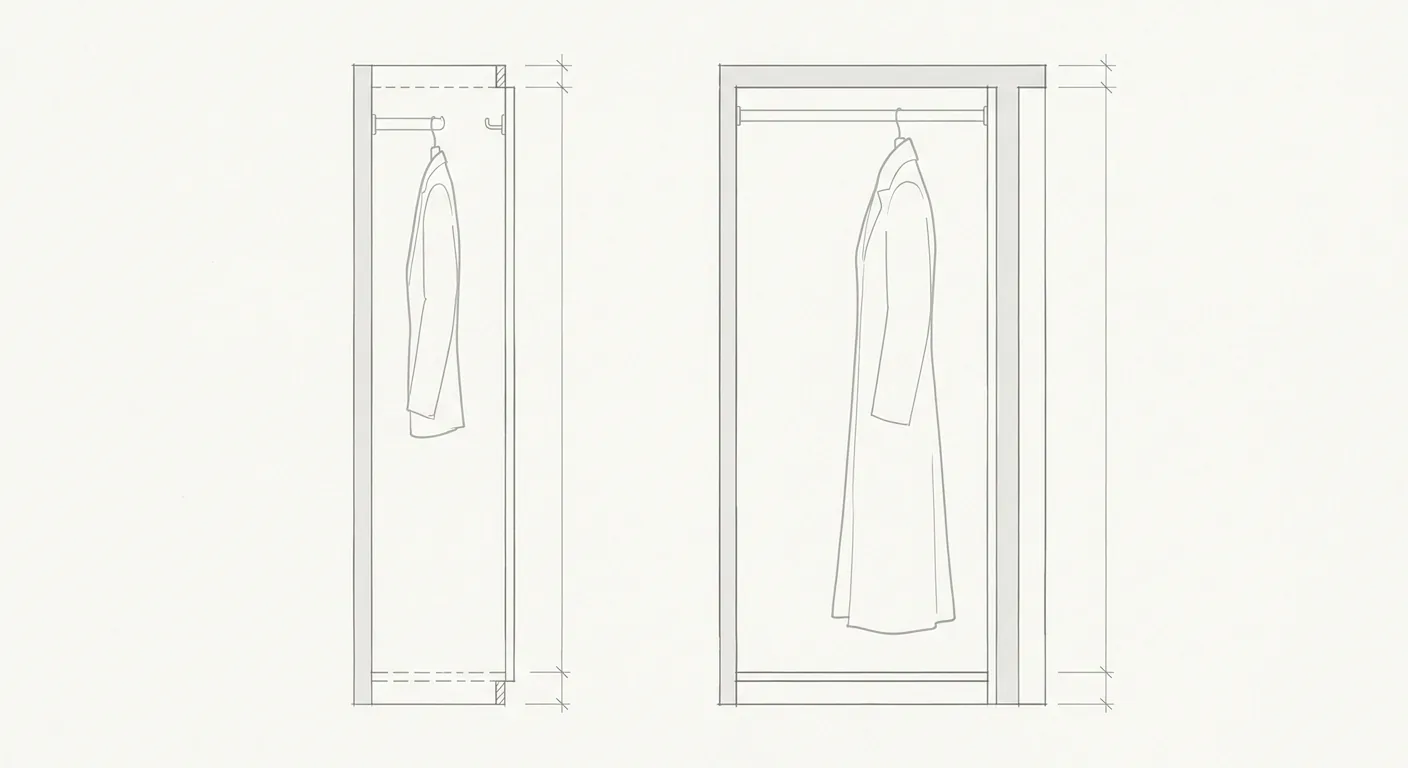
Caption: The thinner it is, the shallower; the bulkier it is, the deeper — a soiled-garment cabinet at 35–40 cm side-hung for ventilation, a coat cabinet built to a full 60 cm with 130–150 cm of vertical hanging clearance (industry rules of thumb)
How Deep Should a Soiled-Garment Cabinet Be
A soiled-garment cabinet holds outerwear you've worn once but don't need to wash yet, usually set up in an entryway or by the bedroom door. A depth of 35–40 cm is enough, typically using hooks or a short rod to side-hang a small amount of outerwear — the priority is ventilation, not maximum capacity. Building it too deep just makes the outerwear stuffy and poorly ventilated.
A soiled-garment cabinet is one of the rare cases where you deliberately build it shallow. Its depth logic runs exactly opposite to the main wardrobe — the main wardrobe wants depth for a good forward hang, while the soiled-garment cabinet wants shallowness for ventilation.
Depth Recommendations for Coats, Down Jackets, and Long Outerwear
On the flip side, coats, down jackets, and long trench coats are much bulkier than shirts. Build these to a full 60 cm depth, with 130–150 cm of vertical hanging clearance, so the hem doesn't drag on the floor or get crushed from front-to-back pressure. A thick down jacket squeezed into too shallow a cabinet will have its loft flattened.
There's one often-overlooked point: a corner cabinet or one under a beam has its depth eaten into by the structure. A wall that looks like 60 cm might only leave 45 cm once you account for the beam or column. Measure and subtract the structural intrusion first before calculating your usable clear depth.
4Verify Depth With Roomfit's Elevation Design: Place a Hanging Rod in the 1:1 Canvas to See if It's Enough
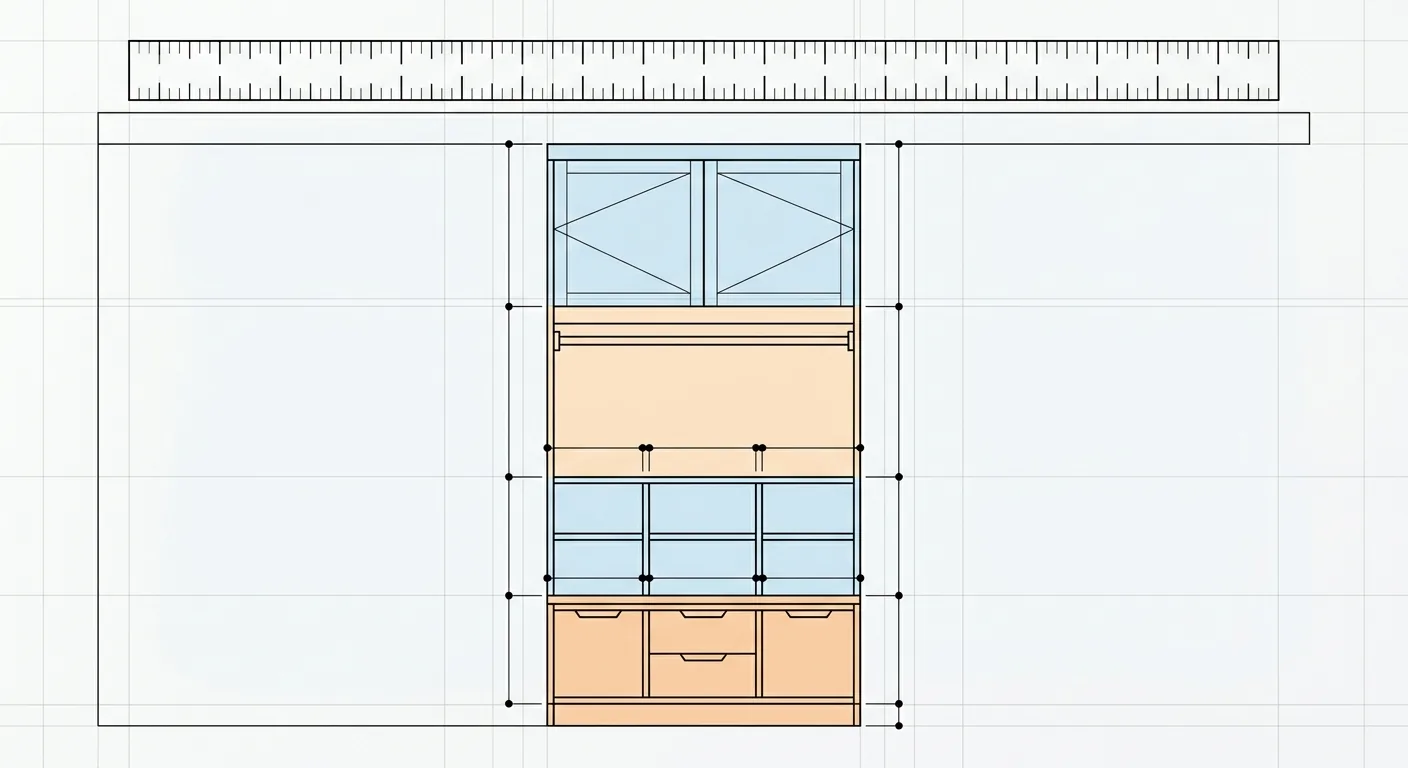
Instead of repeatedly converting "does 55 cm hang okay" in your head, just draw the depth out and look at it directly. In Roomfit's (roomfit.app) Cabinet Elevation Design, pull out a hanging rod and place a garment's footprint on a true 1:1 canvas, and the system automatically marks the depth-direction dimension chain — for example, an interior clear depth of 55 cm, garment front-to-back footprint of 48 cm, and a 5 cm clearance to the door panel. Whether it's enough is obvious at a glance.
This is far faster than measuring with a tape and doing the math after the fact, and you won't miscalculate.
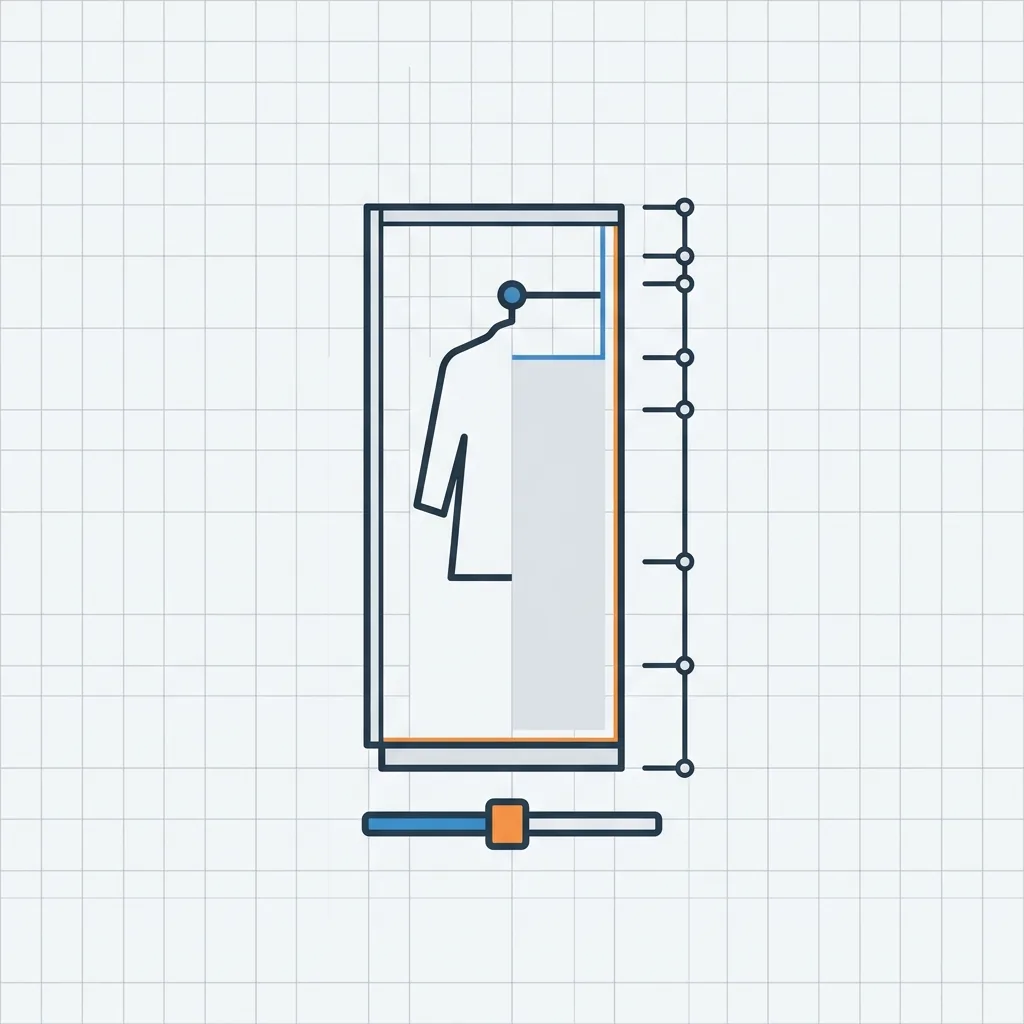
Caption: Place the hanging rod and garment footprint into the 1:1 canvas, and the system automatically marks the depth dimension chain (clear depth, garment front-to-back footprint, clearance to the door panel); if it's not enough, deepen it or switch to a side-pull rod on the spot
Pulling Out a Hanging Rod and Garment Footprint in Cabinet Elevation Design
The operation is intuitive: set the cabinet depth to the number you measured on site, pull out a hanging rod, and place a footprint representing a garment. The tool displays, at true 1:1 scale, how much depth the garment's front-to-back footprint takes up and how much clearance is left.
When we tried it ourselves, placing a thick-coat footprint into a 50 cm cabinet, we immediately saw the garment's front edge nearly touching the door panel — this kind of "just barely about to hit" situation is hard to picture in your head, but very obvious once it's drawn.
The System Automatically Marks the Depth Dimension Chain — Adjust on the Spot If It's Not Enough
What do you do when you see the depth isn't enough? Adjust it right there. Add 5 cm to the depth, or switch that segment to a side-pull rod or shelves, and the dimension chain updates immediately so you see the new result right away. No need to wait until after construction to regret it, and no need to run back and forth to the site.
The finished elevation drawing is drawn to your home's actual wall dimensions and can be saved directly as an image to bring to a vendor. Depth, hanging rod height, and shelf spacing are all labeled — no more communicating by word of mouth. For how this depth number then converts into system cabinet pricing, see How to Calculate System Cabinet Dimensions and Pricing.
5FAQ
What Depth Is Safest for a Wardrobe?
Aim for 60 cm including the door panel if you want a forward hang, leaving an interior clear depth of 55 cm or more so shirts, coats, and dresses can all hang facing forward without touching the door (industry rule of thumb, verify with on-site measurement). A standard hanger has a shoulder width of about 42–45 cm, and with fabric thickness and front-to-back clearance added, 55 cm is the threshold for a comfortable forward hang. If your wall space is tight and you can't reach that, consider a side-hang or shelf approach instead — don't force a forward hang just to cram in a cabinet.
What Do I Do If I Can Only Build 45 cm?
45 cm doesn't work for a forward hang, but you don't need to tear it out and rebuild. Switch to a side-pull extendable rod so clothes face sideways — even around 45 cm still works for hanging — or switch that segment to folding shelves (30–40 cm spacing) or drawers for undergarments. Depth is a fixed physical constraint; choosing the right hanging, folding, or storage method for the depth you have works much better than forcing in a single forward-hanging rod.
How Deep Should a Soiled-Garment Cabinet Be?
35–40 cm is enough. A soiled-garment cabinet holds outerwear you've worn once but don't need to wash yet, typically using hooks or a short rod to side-hang a small amount of clothing — the priority is ventilation, not maximum capacity. Building it too deep just makes the outerwear stuffy and poorly ventilated. It's one of the rare cases you deliberately build shallow, with depth logic running exactly opposite to the main wardrobe, which wants depth for a good forward hang.
How Deep Should a Coat Cabinet Be?
Build it to a full 60 cm, with 130–150 cm of vertical hanging clearance. Coats, down jackets, and long trench coats are much bulkier than shirts — insufficient depth causes front-to-back crushing and deformation, and a thick down jacket's loft gets flattened, while insufficient clearance means the hem drags on the floor. One thing to remember: a corner cabinet or one under a beam has its depth eaten into by the structure, so measure and subtract the beam or column intrusion first before calculating usable clear depth.
Do I Have to Tear Out and Rebuild if Depth Isn't Enough?
No. When depth isn't enough, changing the internal division or adding a side-pull rod can save it — a side-pull rod for coats on the upper segment, drawers or folding shelves on the lower segment, and it works just as well. Rather than spending money tearing it out and rebuilding, first place the hanging rod and garment footprint into a 1:1 canvas, let the system mark the depth dimension chain, see clearly which segment should hang and which should fold, and only then start construction.
6Fix the Depth First, and the Hanging Method Follows
Wardrobe depth isn't a matter of "deeper is always better" — it's about "matching your clothes and your space." Go for 60 cm if you want a forward hang; if you can only manage 45 cm, switch to side-hanging or shelves; build a soiled-garment cabinet shallow and a coat cabinet deep — the order is always to fix the depth first and let the hanging method follow.
A 5 cm difference decides whether clothes can hang forward, and details like this are the easiest to get wrong when you're only imagining them. Place the hanging rod into Roomfit's 1:1 canvas, let the system automatically mark the depth dimension chain, see instantly whether it's enough, adjust it on the spot if it's not, and the finished drawing is a buildable elevation. To put depth back into the overall plan, go back to the System Cabinet / Wardrobe Planning Overview; for how to size cabinet depth in a dressing room, see Primary Bedroom Dressing Room Traffic Flow and Dimension Planning.
7Related Reading
- Furniture Dimensions Chart Overview: Sofas, Beds, Dining Tables, TV Cabinets, and Clearances in One Place
- Bedroom Design and Primary Bedroom Planning: Dimensions and Traffic Flow for Beds, Wardrobes, and Dressing Rooms
- The Complete Guide to Small-Space Storage Planning: From Seasonal Storage to System Cabinet Traffic Flow
8References
- CNA: Taiwan's Average Household Size Falls to 2.89, Trend Toward Smaller Households (citing Ministry of the Interior statistics, 2026)
- Ministry of the Interior Real Estate Information Platform (residential floor area transaction statistics)
- System Cabinet / Wardrobe Planning Overview: From Dimensions to Internal Divisions in One Guide