The most expensive lesson in moving is often the sofa that gets stuck right at the door. The truck's booked, the crew's arrived, and the measuring only happens on-site. Most people actually have the order backwards: book the truck first, start moving first, and only after hitting a wall do they think, "I should have measured this first."
This article flips that order back around: measure right, place right, and only then start moving. We'll give you a checklist of 8 must-measure dimensions, show you how to lay out furniture at true 1:1 scale on a floor plan in your browser with Roomfit, and walk you through the full 30-day timeline — from measuring and date-picking to hiring movers and moving in.
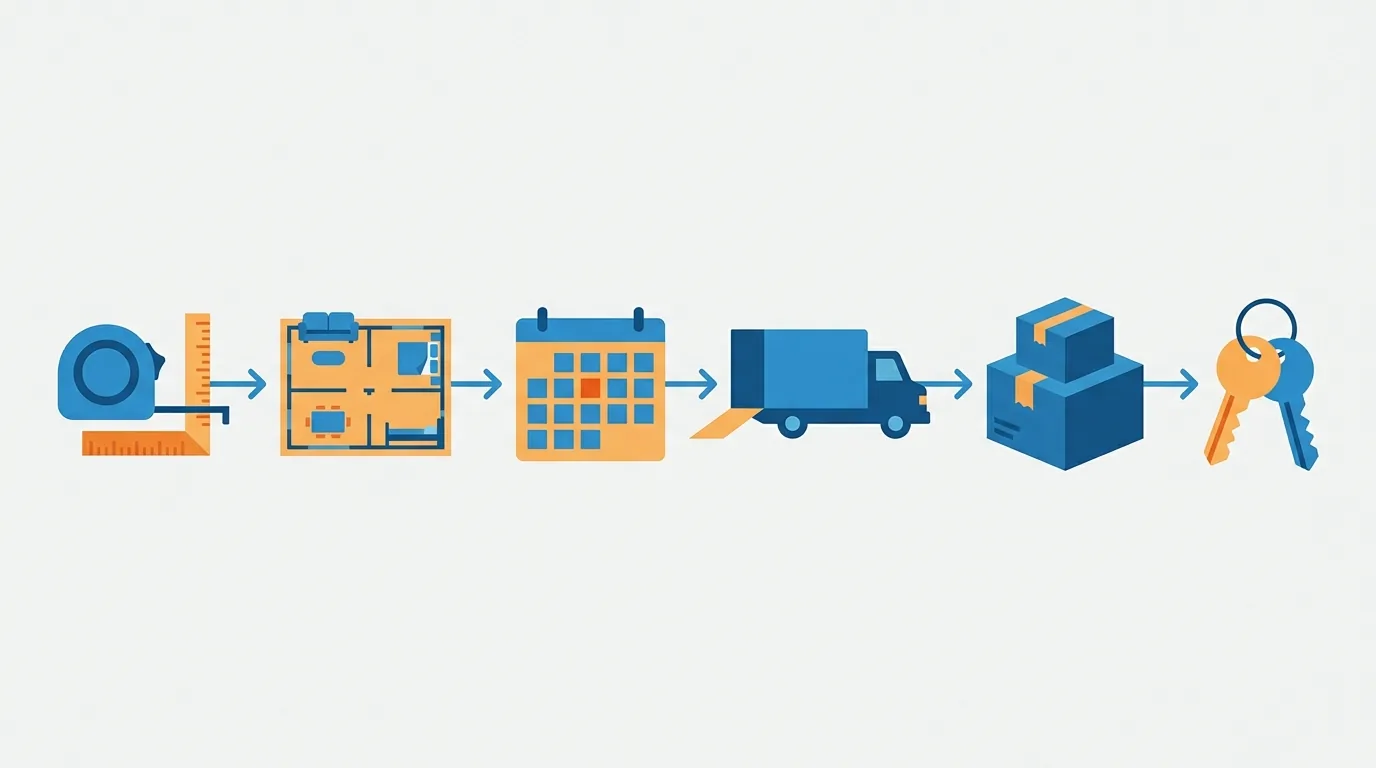
Caption: The six-step moving timeline — (1) Measure dimensions (2) Place with Roomfit (3) Pick a date (4) Hire movers (5) Pack and label (6) Move in
Key takeaway: Moving costs are set by truck size, distance, floor level, and item count — a 5-ton truckload typically runs NT$2,800 to NT$5,800 (PRO360, 2026). Whether something fits shouldn't be a surprise you discover after moving it in — measure the 8 key dimensions first and lay everything out at 1:1 scale in Roomfit, so you book the right truck and place everything correctly the first time.
1Why Measure Furniture and Appliances Before You Move? The Real Cost of Things Not Fitting
The cost of something not fitting is rarely as simple as a return. A 5-ton truckload typically runs NT$2,800 to NT$5,800 (PRO360, 2026), and if things don't fit on-site and you need a second truck, that's the same amount paid all over again. Get the measurements wrong, and you're the one footing the bill.
Moving should follow three steps in order: measure, place, move. Measuring captures the dimensions, placing confirms where each piece goes and how the traffic flow works, and moving is just the final execution. The first two steps only need a tape measure and a browser at home; the third is the only one that needs manpower and a truck. Save the expensive step for last, and put the cheap verification step first — that's the logic behind why measuring before moving saves money.
Three Ways Things Go Wrong When You Discover They Don't Fit On-Site
The first: you pay for a wasted trip. A sofa gets stuck at the entryway, and your only options are hauling it back on the same truck or calling a small truck on the spot — every extra distance fee and floor fee applies in full. The second: the furniture can't be returned. Large furniture bought online is past the return window, or a secondhand piece was never returnable in the first place — if it doesn't fit in the room, it just sits in the hallway, tripping you up every day. The third: appliances wear out faster. Cram a refrigerator into a niche that's exactly its size, flush against the wall on both sides, and poor ventilation forces the compressor to work overtime — driving up both your electricity bill and the odds of a breakdown.
All three outcomes share one thing in common: they happen after the furniture is already inside. By then, your only choices are forcing it in or hauling it back out — there's no third option.
Why Measuring First Saves You an Entire Extra Trip
Have you ever calculated what a second trip actually costs? The answer is usually half to a full truck's worth of the original fare. The real key to saving money is knowing your total volume and largest item's dimensions before you ever book a truck. Measure every piece of furniture, add up the volume, and you can pick the right truck tonnage the first time — no more "I thought one truckload would be enough" moments when you're half a truckload short.
We ran into this firsthand while helping a friend move: he insisted "a 3.5-ton truck will definitely be enough," but between the wardrobe, bookshelf, queen bed, and twenty-some boxes of miscellaneous items, they came up a full small truck short on-site. Calling in a backup mini-truck cost several hundred more dollars. After that, the first thing he does before every move now is grab a tape measure and make a list. Measuring first, placing first, then moving saves more than money — it saves you the anxiety of standing on the curb waiting for a second truck.
2The Furniture Measurement Checklist: 8 Must-Measure Dimensions and How to Measure Them
Whether something fits isn't really about the furniture itself — it's about the narrowest point along the path it has to travel. Many people only measure a piece's length, width, and height, but skip the door width, elevator interior, and staircase turns — so the furniture itself is fine, but it gets stuck halfway there. This checklist covers all 8 measurements you need, so nothing gets missed.
Below, we go through each of the 8 items one by one — which line to measure, what tool to use, and where the blind spots are. Grab a 5-meter tape measure and your phone's notes app; have one person hold each end while the other records the numbers, and you can measure everything in half an hour.
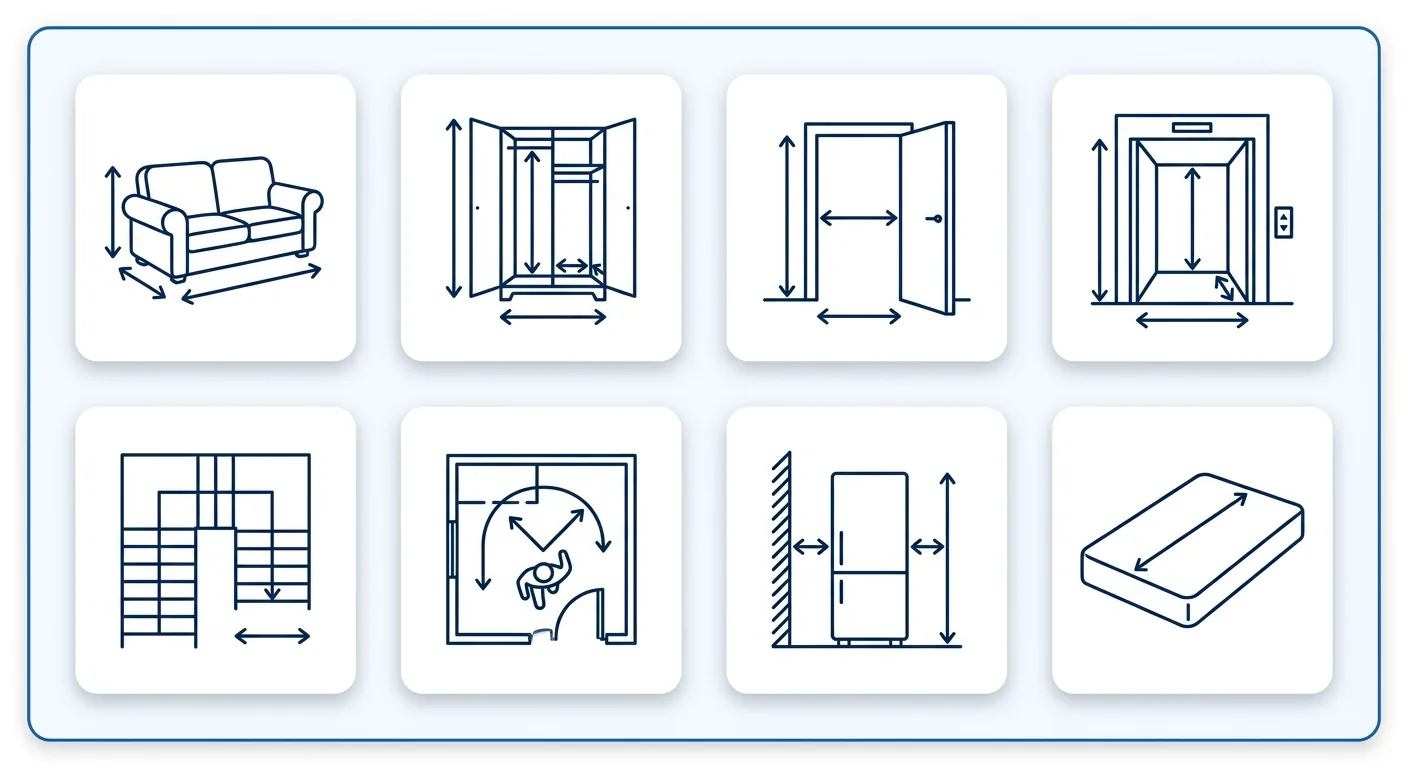
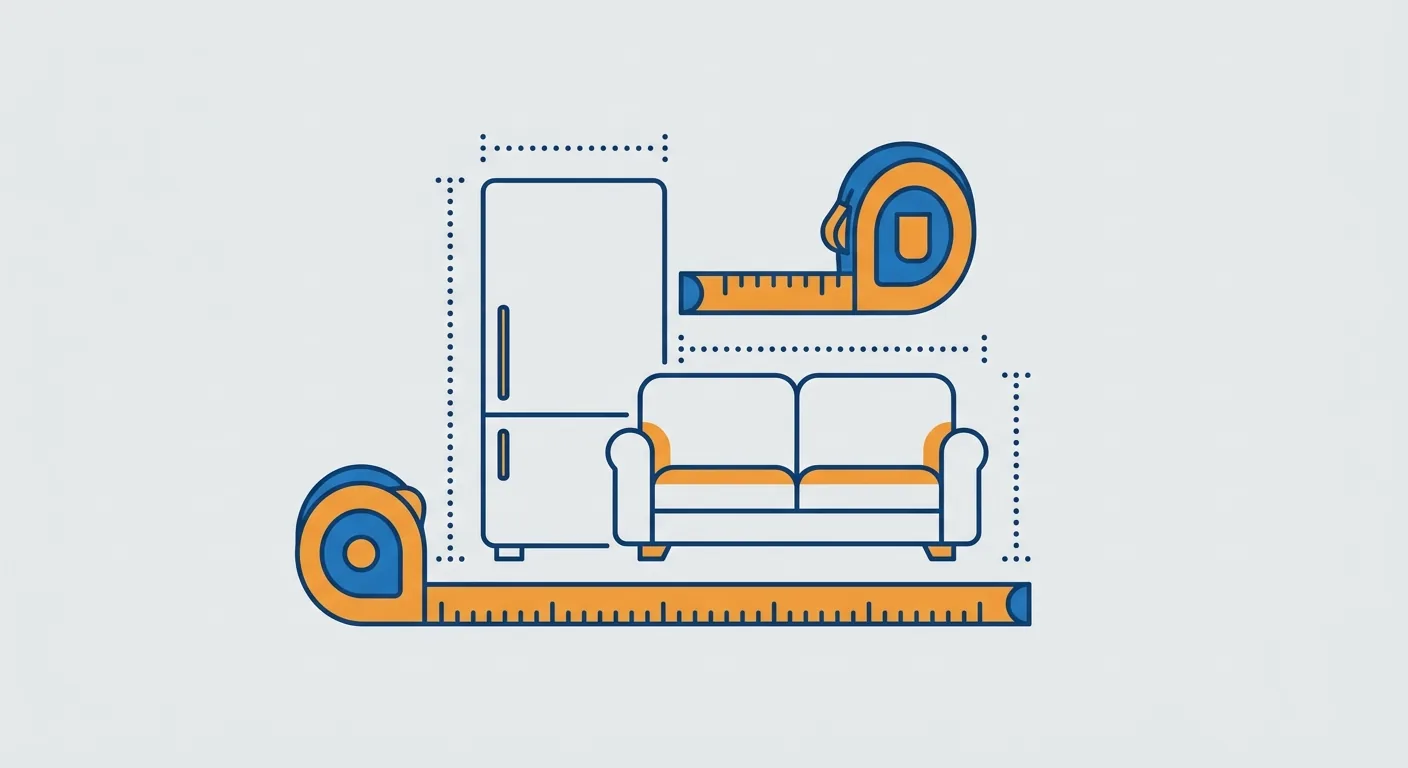
Caption: The 8 must-measure dimensions — (1) furniture length/width/height (2) door width and frame (3) elevator interior and door height (4) staircase turns (5) entryway turning space (6) refrigerator clearance (7) sofa access path (8) mattress diagonal
3 Measurements for the Furniture Itself
The first three items are the furniture's own dimensions. Measure the length, width, and height of every large piece — especially sofas and wardrobes, the pieces most likely to get stuck. When measuring height, remember to include the legs; many people only measure the body and skip the extra 10-odd centimeters the legs add.
The fourth item is the sofa's access baseline. Whether a sofa clears a door isn't about its longest side — it's the shortest side (usually the depth) and the diagonal that matter. Get this measurement right, and you'll know whether you need to carry it upright or angle it through. The same goes for item 8, the mattress: what actually decides success at a narrow door is the mattress diagonal, not its flat width.
The Access Path Through Doors, Stairs, and Corners
Items 5 through 7 are all about the path. Door width needs to be the "clear width" — subtracting the door panel's thickness and any protruding handle. The actual passable width is often several centimeters narrower than the frame itself. This is the number one culprit behind things not fitting, yet it's the most commonly overlooked.
For elevators, measure three numbers: interior width, interior depth, and door height. Whether a long piece of furniture can stand upright inside the elevator depends on the elevator's diagonal space, not just the door width. For staircase corners, measure the turning radius — whether the landing has enough room for a large piece to turn the corner. If it can't clear this point, the furniture has to go through a window by crane instead, which is a whole different cost. The entryway turning radius works the same way — just because the door opens wide enough doesn't mean there's room to turn the corner inside.
Refrigerator Clearance and Mattress Diagonal
Item 8 returns to appliances. Beyond the refrigerator's own body dimensions, you also need clearance for ventilation. Combining recommendations from appliance manufacturers and interior design guides, a typical refrigerator does best with roughly 5 to 10 cm clearance on each side, about 10 cm at the back, and at least 5 cm on top (100 Interior Design, 2025); Taiwan Power Company's energy-saving guidance likewise recommends keeping clearance space around a refrigerator to avoid overworking the compressor (Taiwan Power Company, 2026). Actual figures should follow each model's manual — treat these as general guidelines, not hard rules.
When measuring a built-in niche, measure the "clear width × depth × height" of the space, then compare it against the refrigerator's body dimensions plus clearance. For depth details and a table by capacity, our Complete Guide to Furniture and Appliance Size Fit Checks Before Moving In has a full breakdown — here we're just giving you the overview.
3Placing Furniture at True 1:1 Scale with Roomfit: The Complete Workflow for Getting the Layout Right Before You Move
How do the numbers you measured turn into an answer for "will this fit"? Lay them out on a floor plan and you'll know. Roomfit (roomfit.app) is an online furniture-placement tool at true 1:1 scale — no installation needed, just open it in your browser. Drag each piece of furniture into your floor plan at its actual size, and you can instantly read off how many centimeters of walkway are left or whether there's enough clearance beside the fridge.
Its core purpose isn't rendering a pretty visualization — it's getting the placement right first, and worrying about aesthetics second. Abstract length-width-height numbers become readable positions once they're laid out on a floor plan. The three steps below show you how to lay out your home before you move.
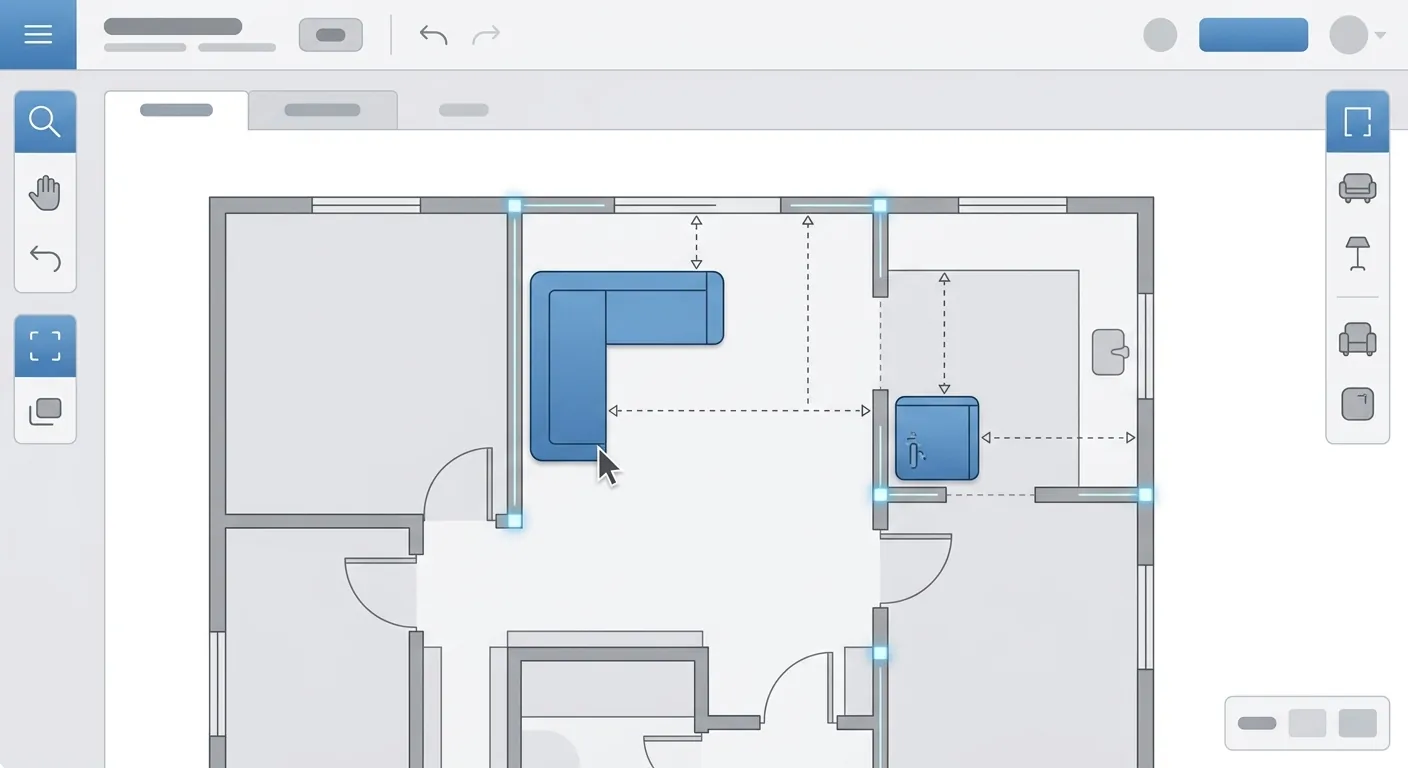
Caption: Placing furniture at 1:1 scale in Roomfit — (1) drag furniture onto the floor plan (2) walkway spacing is labeled automatically (3) snap-align to walls
Step 1: Upload and Calibrate the Scale
Start by uploading your new home's floor plan. Rentals and purchased homes usually come with one — a photo or screenshot works fine. If you really can't find one, measure a few of the room's main edges and draw a rough outline by hand instead. The most important step after uploading is calibrating the scale: use a known real-world length on the floor plan (say, a wall that's 350 cm) to align the on-screen scale, so every piece of furniture you drag in afterward is truly at 1:1.
The more precisely you calibrate the scale, the more reliable the results. Skip this step and every spacing reading that follows will be off.
Step 2: Drag in Furniture at 1:1 Scale and Read the Spacing
Once the scale is set, drag the furniture you just measured into the floor plan at its real size. Put the sofa in the living room, the fridge in the kitchen, the bed in the primary bedroom — placing each piece into position one at a time. Roomfit automatically labels walkway width and appliance clearance, so you don't need a calculator — how many centimeters are left between the sofa and coffee table, or whether the fridge has enough clearance from the wall, shows up as a number right on screen.
The wall snap-align feature keeps furniture flush against the wall, so you're not spending half an hour nudging it straight by hand. The value of this step is simple: before you move, you already know exactly where every piece goes, whether it fits, and whether the walkway will end up blocked.
Step 3: Export Your List and Layout Plan
Once everything's placed, export two things. The first is a furniture list showing each piece's dimensions — use this to estimate volume and calculate truck tonnage. The second is a to-scale layout plan (PDF or PNG) that you can hand directly to your moving company, so they can match up item count and placement on the day.
To be honest about it: the simulation helps you get the direction right and avoid buying or moving the wrong thing, but the final placement on the day still governs. Every feature described here is real — uploading a floor plan, 1:1 dragging, wall snap-align, automatic spacing labels, and list export. There's no "auto-calculates your truck size" or "auto-generates a quote" — features it doesn't actually have. A tool that's honest about what it does is the kind worth trusting before you move.
4Big Furniture and Appliance Moving Techniques: Getting Sofas, Refrigerators, and Mattresses Through the Door
The real key to moving furniture isn't brute force — it's the order you apply force and the angle you go through the door. If a sofa's stuck, think about angling it first; if the fridge just arrived, let it sit before plugging it in; if a mattress is going around a corner, protect the edges first. These few habits save you most of the scrapes and damage. But one thing needs to be said upfront: no technique can save something that simply doesn't fit — getting the measurements right is the precondition, and technique is only the last mile.
Below, we cover the actual force and sequence for the three hardest large items to move.
Carrying Sofas Upright and Removing the Legs
When a sofa gets stuck at the door, don't force it. The first move is deciding whether to carry it upright — standing it on end so the shortest side goes through the door; many sofas that won't clear the door lying flat will clear it standing up. The second move is removing the legs. Detachable sofa legs save another 5 to 15 cm, making both doors and corners easier. Measuring the diagonal is exactly for this moment: if the diagonal is smaller than the door's clear width, angling it through will work.
We once moved a three-seat leather sofa into an old apartment with a door only 78 cm wide — no matter how we angled it flat, it wouldn't clear. We ended up removing all four legs, standing it upright, and angling it through diagonally — it cleared on the first try. If we hadn't measured that diagonal beforehand, we probably would have burned half an hour in the stairwell just guessing.
Why You Should Let a Refrigerator Sit Before Plugging It In
When a refrigerator arrives at your new home, don't rush to plug it in. It inevitably tilts during transport, and the compressor's refrigerant oil can flow into the tubing — powering it on right away risks damaging the compressor. The correct approach is to let it sit in place for a while so the oil flows back before turning it on. The more it tilted, the longer it should sit — generally at least a few hours, and longer still if it was transported lying on its side.
When positioning it, remember to leave clearance space. The 5–10 cm on each side and 10 cm at the back that you measured earlier weren't for nothing — pushing it flush against the wall means higher power bills and a shorter lifespan. Moving it in is only step one; placing it correctly is what makes it last.
Carrying Mattresses Around Corners
A mattress looks soft and easy to carry, but it's actually one of the easiest things to damage internally — bent springs. Before moving it, cover it with a dust cover or a large plastic sleeve to protect against scratches and dirt. When going around a staircase corner, split the job between two people: one leads the turn while the other controls the height of the opposite end, letting the mattress follow the curve of the corner instead of forcing it into a hard 90-degree bend.
Pocket-coil mattresses are especially vulnerable to sharp bends — overbending can deform the internal springs, leaving a soft spot when you sleep. Apply force along the mattress's two long edges, holding it close to your body as you lift; it's both easier and more stable than gripping the four corners.
5The Full Moving Timeline: From Measuring and Date-Picking to Hiring Movers and Moving In
Moving isn't a one-day event — it's a 30-day chain of decisions. Laying it out as a countdown timeline makes it clear what to do at each stage and in what order. The reason the sequence can't be reversed is simple: measuring correctly lets you estimate the right truck, the right truck gives you an accurate quote, and an accurate quote lets you properly compare companies. That cause-and-effect chain is what determines the order of the milestones below.
Below, we break the 30 days into three stages, each linked to a related deep-dive article you can click into whenever you need more detail.
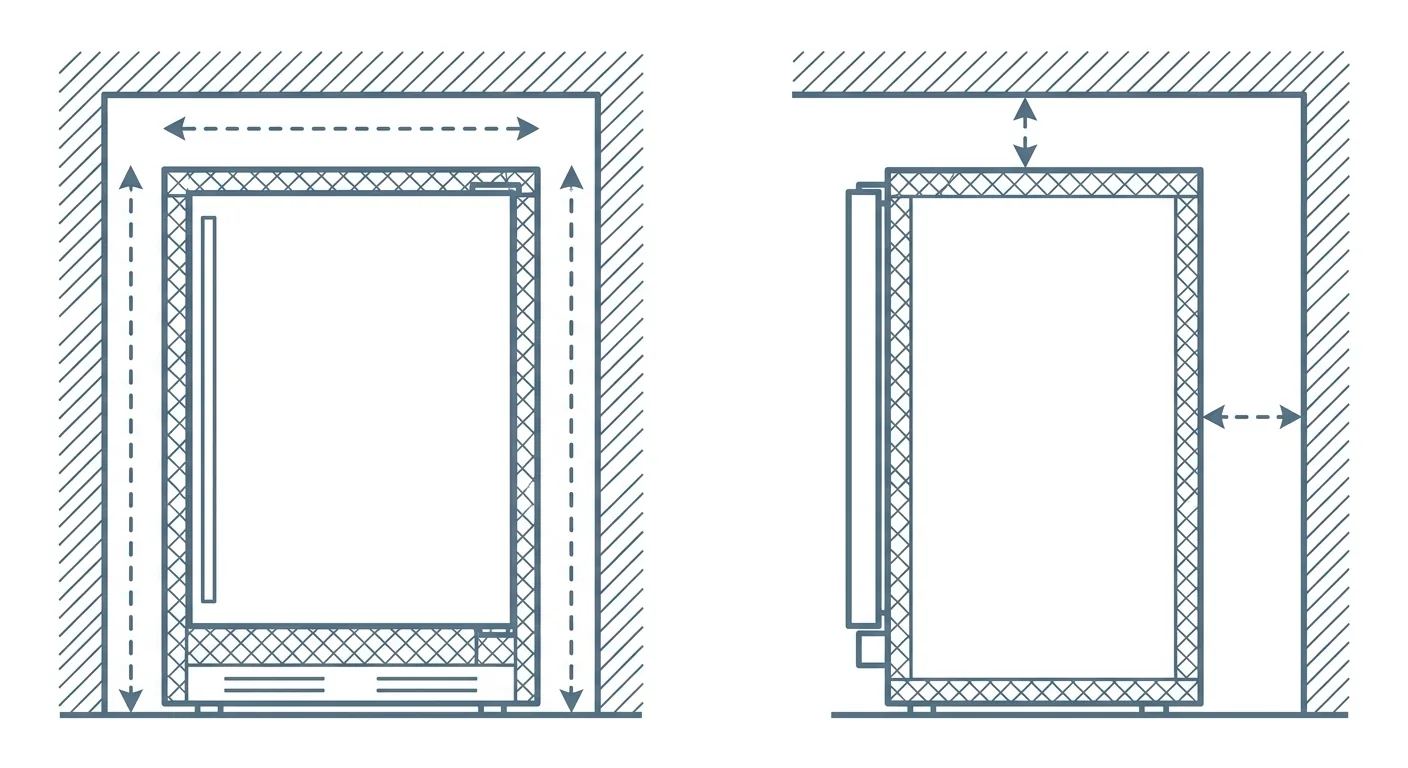
Caption: General refrigerator clearance guidelines — roughly 5–10 cm on each side, about 10 cm at the back, and 5 cm or more on top; actual figures follow each model's manual
30 Days Before Moving Day
In the first week, do two things: measure your dimensions, and lay everything out in Roomfit. Measure every piece of furniture, place it into your new home's floor plan, confirm what fits, and decide early which large items simply won't fit and can be let go of. Then export your furniture list and start estimating volume and truck size, ready to request quotes from moving companies.
This stage is also when you settle on a moving date. If you want to pick an auspicious day, check the almanac for a good date first, then match it against the moving company's schedule — it only counts once both sides align. For date-picking details and customs, see our Complete Guide to Choosing an Auspicious Moving Date and Lunar Seventh Month Customs.
7 Days Before Moving Day
In the final week, the focus shifts to packing and logistics confirmation. Gather boxes, bubble wrap, and labels, then pack and label boxes by room; update your address, empty and defrost the fridge, and keep valuables and important documents with you. This is also when you should reconfirm arrival time, item count, and the quote with your moving company, so nothing's off on the day.
Packing shouldn't be an all-nighter the night before you move — doing it in batches ahead of time keeps you from burning out. For the full packing order, a supply checklist, and decluttering tips, our Moving Checklist and Packing Preparation Guide has a ready-to-follow rundown.
Moving Day and Move-In
On the day, check everything against your layout plan as it's placed. The moving company puts each piece into position following the plan, while you just check off item count against the list and inspect for any bumps or damage. Let the refrigerator sit before plugging it in, place large furniture at its planned spot, and send boxes into the correct rooms by label.
Whether you hold a move-in ritual, and how, is a personal choice. If you want peace of mind, you can pick an auspicious day to cook your first meal or make an offering to the land god; if you're not particular about it, just get the traffic flow and bed placement right and the space will feel right to live in. If it feels off after you've moved in, it's rarely bad luck — it's usually that the placement wasn't planned out beforehand.
6Navigating Cost, Companies, and Checklists: Where to Go Next
The four logistics threads of moving — cost, companies, date-picking, and checklists — all rest on the same foundation: confirming your furniture's dimensions and placement first. Accurate measurements lead to an accurate volume estimate, an accurate volume estimate leads to booking the right truck, and the right truck keeps your quote from jumping. The three sections below take you into the cost, company, and checklist deep-dives.
On cost: how much does a truckload cost, and how are floor fees and overtime surcharges calculated? Moving costs are set by four variables — truck size, distance, floor level, and item count — with a 5-ton truckload typically running NT$2,800–5,800 and stair-carrying adding roughly NT$300–500 per floor (PRO360, 2026). To nail your budget and avoid surcharges, our Complete Breakdown of Moving Costs and Per-Truck Rates has a full rate table and a DIY vs. hiring comparison.
On companies: how do you read moving-company recommendations on forums like Dcard and PTT, and how do you choose between well-known brands and budget options? Taiwan's Ministry of Transportation and Communications maintains a standard moving/freight contract template — spell out item count, dimensions, and scope before signing, so your quote doesn't jump on-site (Ministry of Transportation and Communications, 2007). For a framework on reading reviews and comparing brands and tools like Lalamove and Uber, see our Guide to Moving Company Reviews and Moving Tools.
On checklists: where do you even start decluttering for a move, and what do you do when you have too much stuff? Our Moving Checklist and Packing Preparation Guide lays out the full packing timeline from 30 days out to moving day, a supply checklist, and how to handle decluttering and unwanted furniture, so nothing gets missed. And every question of "will this fit" ultimately comes back to our Furniture and Appliance Size Fit Checks Before You Move In.
7Conclusion: Measure Right, Place Right, Then Move
Moving goes wrong, in most cases, not because you didn't put in enough muscle — it's because you didn't measure early enough. Flip the order to measure, place, then move, and you'll find most disasters are avoidable before you ever book a truck: a sofa stuck at the door, a fridge flush against the wall, furniture piled in the hallway — these are all dimension problems, not strength problems.
Measuring takes half an hour with a tape measure; placing takes a few drags in Roomfit in your browser; moving is the only step that needs manpower and a truck. Put the cheapest verification step first and save the most expensive execution step for last — that's why measuring correctly before you move saves both money and peace of mind. Next time you're moving, don't rush to book a truck — measure first, place first, then move.
8FAQ
Which lines do I need to measure for moving furniture?
Beyond a piece's own length, width, and height, what actually determines whether it fits is the access path: door clear width, elevator interior and door height, staircase turning radius, and entryway turning radius. These four are the ones most often missed, and the main cause of things getting stuck. There are 8 total measurements to take, all doable in half an hour with a 5-meter tape measure. Remember to include furniture legs when measuring height, and subtract the door panel and handle thickness from door width.
How wide does a door need to be for a sofa to fit through?
The benchmark isn't the sofa's longest side — it's the shortest side or diagonal compared against the door's clear width. Clear width subtracts the door panel's thickness and any protruding handle, so it's often several centimeters narrower than the frame itself. If you're not sure it'll clear, you can remove the sofa legs (saving 5–15 cm) or carry it upright and angle it through. Measuring the diagonal beforehand tells you whether you'll need to angle it, so you avoid getting stuck right at the door.
How much clearance should I leave on each side of a refrigerator?
Combining recommendations from appliance manufacturers and interior design guides, a typical refrigerator does best with roughly 5–10 cm of clearance on each side, about 10 cm at the back, and 5 cm or more on top (100 Interior Design, 2025). Insufficient clearance forces the compressor to work overtime and drives up power consumption. Actual figures should follow each model's manual; built-in refrigerators have their own separate specifications, and capacity-by-capacity comparisons are covered in our dedicated measurement article.
Can I use Roomfit if I don't have a floor plan?
Yes. As long as you have rough dimensions, you can sketch the room outline first and then place furniture. Rentals and purchased homes usually come with a floor plan — just photograph or screenshot it and upload. If you can't find one, measure a few of the room's main edges and draw it by hand instead. The key is calibrating the scale: align a known real-world length against the on-screen image, so furniture you drag in afterward is truly at 1:1 — the more precise the calibration, the more reliable the result.
How do I use my measurements to book the right truck?
A furniture list exported from Roomfit lets you estimate total volume and item count, so you can book the right truck tonnage the first time and avoid discovering on-site that things don't fit and needing a second trip. At roughly NT$2,800–5,800 per truckload for a 5-ton truck (PRO360, 2026), a second trip means paying that amount all over again. Handing the list to your moving company also makes their quote more accurate.
9Related Reading
- Roomfit Measuring and Scale Tool Guide: Calibrating Your Floor Plan Scale
- Roomfit Guide: From Uploading a Floor Plan to Exporting a Furniture List
- Complete Furniture Dimensions Reference: Sofas, Beds, and Dining Tables at a Glance
- Complete Sofa Dimensions Guide: How to Measure 1-, 2-, 3-Seaters and L-Shapes
10References
- PRO360 — How Are 2026 Moving Company Costs Calculated? Latest Rates and Price List
- 100 Interior Design — Skipping This Refrigerator Clearance? Worse Cooling, 2x the Electricity Bill
- Taiwan Power Company — Energy-Saving Tips: Watch the Clearance Space Around a Cabinet-Enclosed Refrigerator
- Ministry of Transportation and Communications — Standard Moving/Freight Contract Template and Consumer Information
- Executive Yuan — Standard Moving/Freight Contract Template