Floor Plans & Layout
Getting ready to renovate an old house, the three things you most want to figure out are usually: is there any subsidy available, roughly how much it'll cost, and whether it's actually worth doing at all. Unfortunately, subsidy information is scattered across county and city government websites, and cost estimates vary wildly — even scrolling through PTT and Dcard just leaves you more confused.
This guide pulls together the subsidy application framework, where to check by county and city, how to work out a cost budget, and the common takeaways from people who've been through it. One thing up front: subsidy amounts, caps, and conditions change every year, so this article states everything as "per the current-year announcement from each county/city government and central authorities" and doesn't write down fixed figures — checking the latest announcement yourself is the most accurate approach.
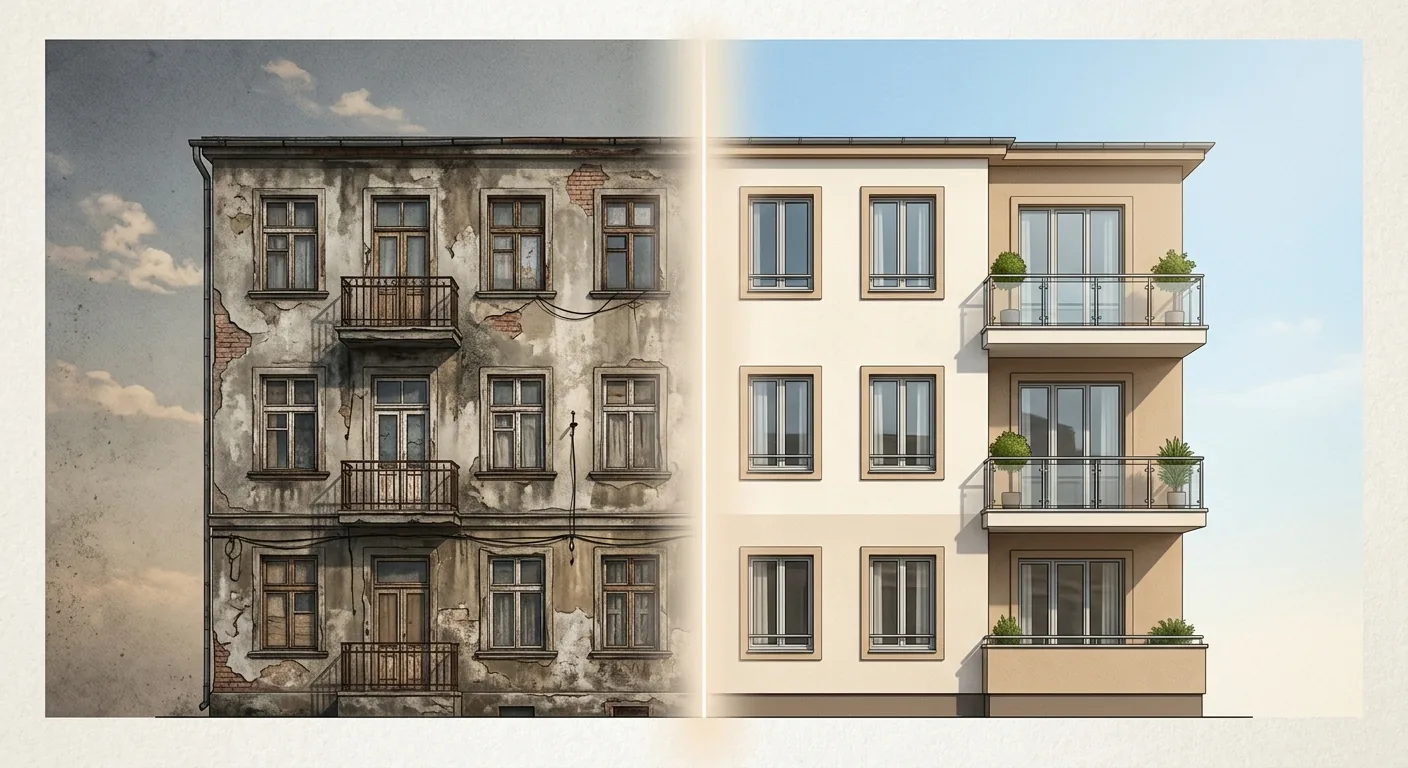
Caption: Old house renovation means going from "livable" to "actually pleasant to live in" — getting the subsidy and budget right means starting construction without anxiety
Key takeaway: Roughly 51% of homes nationwide in Taiwan are over 30 years old, with an average age of about 32 years — meaning one in every two households lives in an old house (591 Real Estate News, citing the Ministry of the Interior, 2026). The demand for renovation is huge, but subsidy amounts and conditions vary by county and city, so always defer to the current-year announcement.
To first get a sense of the layout planning sequence for your renovated space, pair this with our complete layout planning process guide; this article focuses on "subsidies, costs, and pre-construction prep."
Is there really a subsidy for renovating an old house? Yes, but it's not that "renovation" itself is subsidized — different policies each cover a slice. Roughly 51% of homes nationwide are over 30 years old, with an average age of about 32 years (591 Real Estate News, citing the Ministry of the Interior, 2026), so the government runs a range of programs covering housing repair, facade improvement, seismic reinforcement, accessibility upgrades, and energy efficiency, each with its own eligibility and criteria.
We've looked into several county and city announcements for family members, and our biggest takeaway is: two programs both called "repair subsidy" can cover completely different things — one county's covers low-income household housing, another city's covers facade renovation. Don't assume you qualify just because of the title; always click through and check the actual conditions.
The above are common directions only; actual subsidy items and amounts are subject to the current-year announcement from each county/city government and central authorities.
Eligibility varies by program, but common criteria include: whether the building's age and use fit the requirements, whether the applicant is the registered owner, family status category (some programs are limited to disadvantaged households), and whether the property falls within a specific designated area. Conditions are adjusted every year, so always check the latest announcement before construction — don't rely on outdated information or hearsay.
The typical sequence is: confirm your building's age and use meet eligibility → prepare ownership and current-condition documentation → submit to the competent authority during the announced application window → construction after approval → reimbursement after completion. Slots and timelines are limited — securing eligibility before hiring a contractor tends to work out better than the reverse.
How do you check subsidies by county and city? Start with one rule of thumb: the higher a county or city's share of old housing, the more likely it is to have relevant programs. Taipei, for instance, has close to 72% of homes over 30 years old, the oldest of the six special municipalities (591 Real Estate News, citing the Ministry of the Interior, 2026), and this kind of aging city tends to have relatively more housing-repair and urban-renewal resources. The table below helps you find your own city, and the amount column deliberately follows the current-year announcement rather than listing any unverified figure.

Caption: Subsidy information is scattered across county and city government websites — go to the official source and cross-check the current-year announcement, more reliable than secondhand forum accounts
| County/City | Common Subsidy Direction | How to Check (Recommended) |
|---|---|---|
| Taichung | Housing repair, seismic reinforcement, facade improvement | Search "Taichung old house repair subsidy" + the city's urban development/construction management agency website |
| Taoyuan | Housing repair, hazardous/old building reconstruction | Search "Taoyuan housing repair subsidy" + city government announcements |
| Tainan | Old house revitalization, repair, cityscape improvement | Search "Tainan old house subsidy" + the city's urban development agency website |
| Kaohsiung | Housing repair, facade cladding, seismic reinforcement | Search "Kaohsiung old house subsidy" + city government announcements |
| New Taipei | Housing repair, hazardous/old building reconstruction, urban renewal | Search "New Taipei old house renovation subsidy" + city government announcements |
The table above lists only general direction and how to search; the specific agency name, subsidy items, caps, and conditions vary by county/city and change every year — always defer to the official current-year announcement.
The most reliable approach is to start with your own county/city government's official website (usually the urban development bureau, public works bureau, or building management agency), then search "[county/city name] + housing repair / old house subsidy." Don't rely solely on forum posts or secondhand figures from agents — those are often outdated or refer to a different program.
Cross-county common categories are broadly housing repair, seismic reinforcement, facade improvement, and accessibility upgrades, with some paired with central government programs. If you're applying to both central and local programs, check whether there's a restriction against double-dipping.
Subsidy caps, ratios, and eligibility can all change with each year's announcement, and the "$X from county Y" figures circulating online are often outdated. Rather than copying a number that might be stale, it's better to build the habit of "checking the current-year announcement" — that's exactly why this article doesn't quote any figures.
How much does an old house renovation cost per ping? Renovation contractors' quotes vary widely and there's no official statistic — the commonly cited industry range is roughly NT$80,000–200,000 per ping: light renovation about NT$40,000–60,000/ping, moderate about NT$60,000–100,000/ping, and heavy (very old building, full scope) NT$100,000/ping or more. This is just a range for budgeting purposes; actual pricing depends on the on-site quote.

Caption: Common renovation cost allocation — roughly 50% basic construction, 40% interior finishing, 10% furniture and appliances
Don't budget by looking at a total figure — break it into line items first, then add them up for accuracy:
A common cost allocation is roughly 50% basic construction, 40% finishing, 10% furniture and appliances (Green Furniture).
NT$500,000 tends to cover partial repairs and equipment swaps (say, renovating one kitchen or bathroom, replacing flooring and paint); NT$1,000,000 can cover a fairly complete renovation, including some plumbing/electrical work and minor layout adjustments. Cost per ping varies a lot by building condition, location, and materials — the range above is just for budget reference; actual figures depend on the quote.
The most painful part of an old house renovation is hidden costs: replacing all the plumbing, structural reinforcement, debris removal, temporary housing during construction — all easy to underestimate. We recommend keeping a 10–20% buffer in your budget. You might think: shouldn't a good quote cover everything? The problem is that opening up walls in an old house often turns up surprises, and without a buffer you'll blow through the budget.
Is renovating an old house worth it? There's no universal answer, but there's a framework for judging. Homes over 50 years old in Taiwan already exceed a million units (591 Real Estate News, citing the Ministry of the Interior, 2026), and with that many old homes needing either renovation or reconstruction, the key is first assessing the building's condition (whether the structure still holds up), the location, and whether it's for your own use or rental, then comparing that against the cost of "just buying a new one."
Common channels include renovation loans and mortgage top-ups, with the amount and interest rate depending on individual conditions and the specific product. This is just an overview of "what directions exist" — for actual rates and amounts, consult a financial institution directly; don't trust a fixed number you saw online.
We once went through a cost estimate for an old house with a family member, and the biggest lesson was hidden costs — just opening up the walls and finding the plumbing needed a full replacement added 20% to the original budget. Good thing we'd built in that 20% buffer, or we'd have run out of money partway through.
Going through renovation discussions on PTT, Dcard, and Mobile01, the common advice from people who've done it boils down to: keep budget flexibility, choose your contractor carefully, supervise the site in person, and get the contract and quote in writing. This is community experience, not a guarantee — every case differs a lot, but the direction is worth heeding. As for timeline, from assessment, design, and contracting to completion, the bigger the scope, the more design changes, and the worse the labor/material shortages, the longer it takes.
Once you've checked the subsidy and budgeted the cost, the single most important thing to do before construction is to test-fit your "post-renovation layout" on a floor plan first. Old house renovations often involve adjusting partitions, and with the average home nationwide at about 32 years old (591 Real Estate News, citing the Ministry of the Interior, 2026), the existing layout usually no longer fits current living habits — discovering the furniture doesn't fit only after demolition is too late.
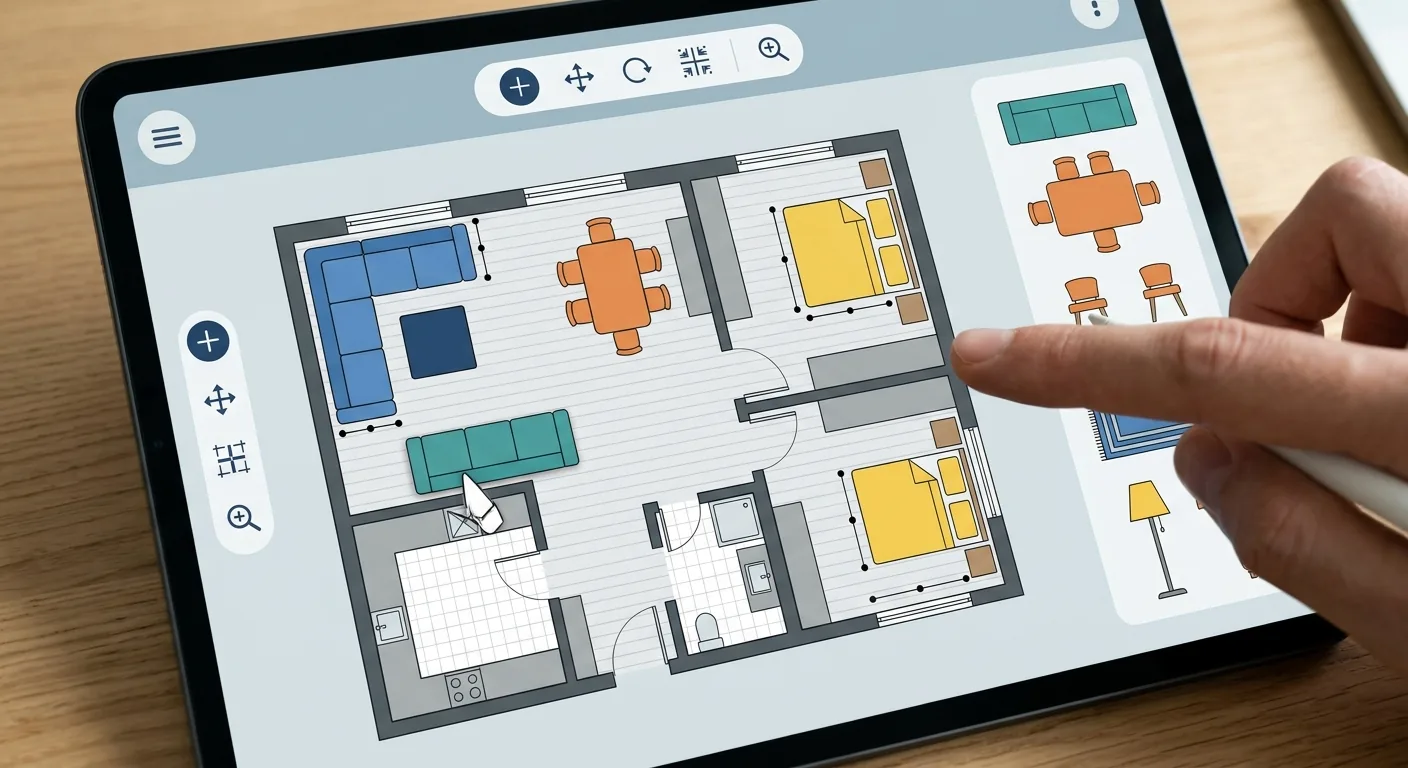
Caption: Upload the existing layout, adjust partitions per your renovation plan, drag furniture in at true 1:1 dimensions, and see at a glance whether walkways and storage are adequate
Upload your current floor plan, adjust partitions per your renovation plan, and drag the furniture you want to keep or buy into it at true 1:1 dimensions. The system labels the spacing automatically, letting you confirm in advance whether the walkways are wide enough and the storage will fit. To double-check walkway and circulation dimensions at the same time, pair this with our walkway width and circulation planning guide.
The most valuable part of a renovation is the chance to fix circulation that's never worked well. Simulate your planned entry, household, and guest paths first, so you can align on requirements with the designer and contractor. For a full-home renovation on a townhouse or multiple floors, see our complete townhouse and multi-house-type layout planning guide; for examples by room, see our room-by-room floor plan examples.
Honestly, a tool is for catching the big picture early and avoiding a bad purchase or rework — actual construction should still rely on on-site measurement and professional structural assessment. But test-fitting furniture and circulation ahead of time means fewer on-site changes, which lowers the odds of needing extra budget. If you don't want to install software and would rather draw directly online, see our simple floor plan app and online tool comparison. For the full planning process, revisit our complete layout planning process guide any time.
The sequence for an old house renovation is actually quite clear: first check your county/city's current-year subsidy announcement to confirm eligibility, then break down the budget by line item with a 10–20% buffer, and finally test-fit the new layout on a floor plan before hiring a contractor. Don't rely on secondhand figures for subsidy amounts — defer to the official announcement; budget in ranges and defer to the actual quote; and use test-fitting to verify the layout. Get these three steps right, and your renovation will hit far fewer snags.
There's no single "renovation subsidy" — it's spread across housing repair, facade improvement, seismic reinforcement, accessibility upgrades, hazardous/old building reconstruction, and other separate programs, each with its own eligibility and threshold. Roughly 51% of homes nationwide are over 30 years old (591 Real Estate News, citing the Ministry of the Interior, 2026), so there are quite a few relevant resources. For actual items and eligibility, always defer to the current-year announcement from each county/city government and central authorities.
Subsidy amounts, caps, and ratios vary by county/city and program, and change every year — this article deliberately provides no fixed figure, to avoid you copying outdated information. The correct approach is to search "[county/city name] + housing repair / old house subsidy" and go straight to your county/city government's official website for the current-year announcement, or contact the local urban development or building management agency. Slots and timelines are limited, so it's safer to confirm eligibility before hiring a contractor.
The market range is roughly NT$80,000–200,000 per ping — about NT$40,000–60,000 for light renovation, NT$60,000–100,000 for moderate, NT$100,000 or more for heavy. This is a commonly cited industry range from renovation contractors, not an official statistic. This is just a reference range for budgeting; the real amount is heavily influenced by building condition, location, and materials, so always defer to on-site estimates and quotes, and remember to reserve a 10–20% buffer for hidden costs.
It depends on structure, location, and needs. If the main structure is sound and it's just old, and you want to stay where you are, renovating is usually worthwhile; if seismic safety is a concern, get a structural assessment first before deciding. Homes over 50 years old in Taiwan already exceed a million units (591 Real Estate News, citing the Ministry of the Interior, 2026), and renovating or rebuilding is a shared challenge for a lot of homeowners — compare the cost of renovating against the cost of buying a new home before making the call.
From assessment, design, and contracting to completion, the timeline depends on scope — partial repairs are shorter, a full-home renovation is longer. The main factors affecting time are the scope of work, how many design changes come up, and labor/material shortages. The common advice from PTT and Dcard veterans is to build in buffer time and not lock in a fixed handover date (community experience, not a guarantee). Finalizing the new layout on a floor plan before construction reduces on-site changes and shortens the back-and-forth revision time.
Arrange furniture in your space at true 1:1 scale with Roomfit and see exactly how much walkway is left — no install, no sign-up.
Start with Roomfit →